12 Front Yard Landscaping Ideas Built for Arizona’s Heat

Arizona doesn’t play fair with grass. You water it every day in July, and it still turns brown by August.
I get why so many homeowners here just give up on the whole idea of a green lawn. The heat wins every time.
But giving up on grass doesn’t mean giving up on curb appeal. Some of the best-looking front yards in the state don’t have a blade of grass anywhere.
Cactus gardens, boulder accents, gravel beds, wildflower drifts, they all do something grass never could out here. They thrive.
This list rounds up 12 front yard ideas built for Arizona’s climate, from bold saguaro landscapes to soft, low-water flower beds.
What Are the Key Concepts of Designing a Front Yard Arizona Landscape?
Before you dive into the list, let’s break down what actually makes an Arizona front yard work. It’s not just swapping grass for gravel.
Work with the sun, not against it.
Arizona sun is intense, and it hits different parts of your yard differently. South and west-facing beds bake all afternoon. North-facing spots stay cooler and hold moisture longer.
I always map out sun exposure first, then pick plants for each zone instead of forcing one plant type across the whole yard.
Layer your plant heights.
The best desert yards on this list all do one thing well: they stack tall, medium, and low plants together. Saguaros or ocotillo go in back.
Agave and yucca fill the middle. Low succulents or wildflowers spill out front. This layering gives your eye somewhere to travel, and it keeps a cactus-heavy yard from looking flat.
Choose your ground cover with drainage in mind.
Gravel, decomposed granite, and rock mulch all do more than look good. They keep roots from sitting in water, which matters here since Arizona soil drains fast but summer monsoons can dump a lot of rain at once.
Skip bark mulch. It breaks down fast in this heat and needs constant replacing.
Use boulders and hardscaping as anchors.
A yard full of small plants can look busy without something bigger to ground it.
Boulders, dry creek beds, and stone pathways give your eye a resting point. They also cost less to maintain than plants, since they never need water at all.
Plan for mature size, not just today.
Saguaros, palo verdes, and agave all start small and get big.
I’ve seen too many yards where plants get crammed in tight, then crowd each other out within a few years.
Give each plant room to reach full size from the start, even if the bed looks a little sparse the first season.
Add color with restraint.
Desert yards don’t need to be all green and gray. Wildflowers, lantana, and flowering cactus bring in reds, yellows, and purples without pulling much water.
But too much color competes for attention. Pick one or two flowering plants per bed and let the structural plants carry the rest.
Put these together, and you get a yard that actually holds up here. It looks good in June, not just in the listing photos, and it doesn’t fall apart the first time you miss a week of watering.
Also read: 13 Front Yard Flower Beds Against the House
12 Arizona Front Yard Landscaping Ideas
1. Sculpted Shrubs with Gravel and Barrel Cactus
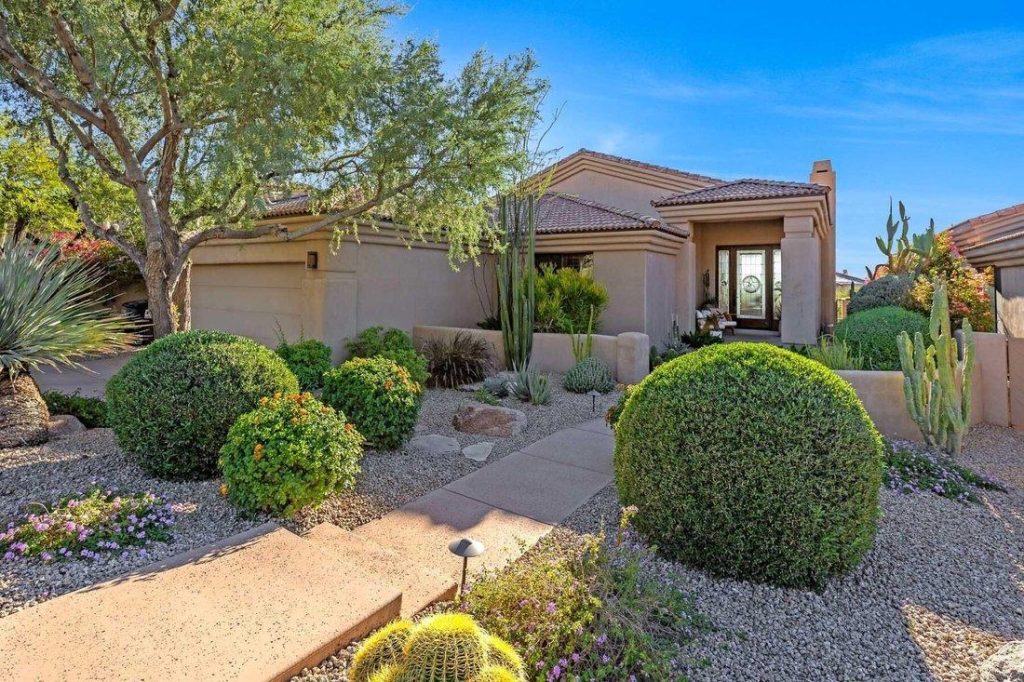
I love how this one balances soft and spiky. Rounded, ball-shaped shrubs sit next to spiky saguaro and golden barrel cactus, and the contrast makes both stand out more.
Gravel fills in around the plants instead of mulch. It stays put in wind, doesn’t attract termites, and reflects heat away from the house.
A simple concrete path cuts through the bed, so the whole thing still feels tidy and intentional. You get structure without looking stiff.
Purple trailing lantana and small flowering shrubs tuck in near the edges. They add color low to the ground without competing with the bigger shapes.
This works especially well if your home has a more formal or Mediterranean-style exterior. The clipped shrubs echo that same polished look, just without the water demand of boxwood hedges back east.
Best for: Formal or Mediterranean-style homes
Maintenance: Low to medium (shrubs need occasional shaping)
Cost range: Mid
Pairs well with: Golden barrel cactus, trailing lantana, decomposed granite
2. Boulder-Anchored Desert Yard
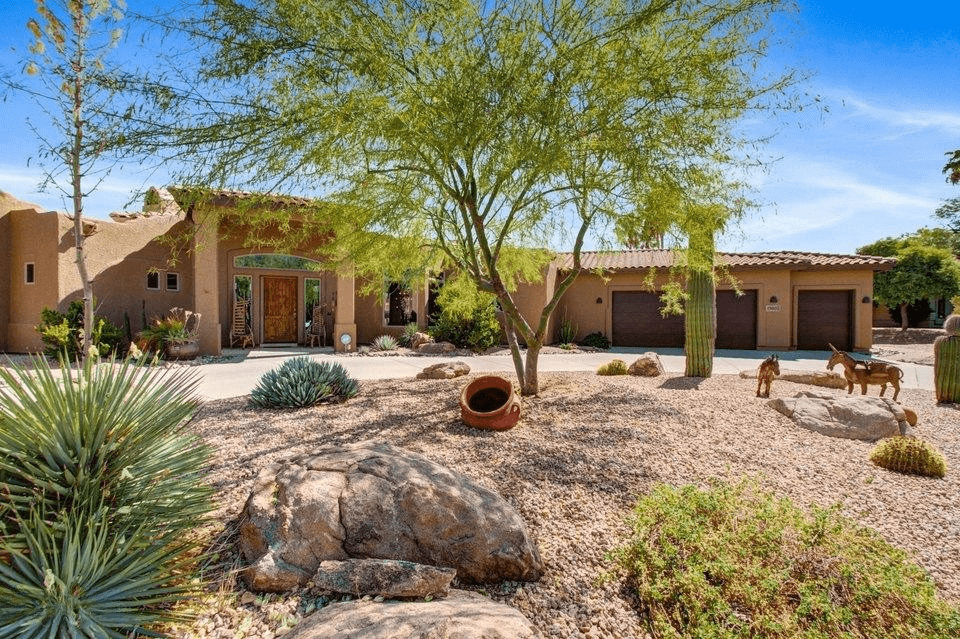
Sometimes the simplest move makes the biggest impact. Here, a few large boulders do most of the visual work, anchoring the whole front yard.
A palo verde tree provides light, filtered shade without blocking the house. Its green bark and yellow spring blooms add color even when nothing else is flowering.
Agave and small cacti fill the gaps between boulders. They don’t need much, just good drainage and sun.
What I like most is how uncluttered it feels. You’re not managing dozens of plant varieties. You’re working with a handful of strong elements and letting them breathe.
This is a smart pick if you want a low-fuss yard that still photographs well. It’s also budget-friendly since boulders and gravel cost less over time than a bed full of perennials.
Best for: Budget-conscious homeowners, minimalist styles
Maintenance: Low
Cost range: Budget to mid
Pairs well with: Palo verde trees, agave, decomposed granite
3. Layered Cactus and Succulent Bed
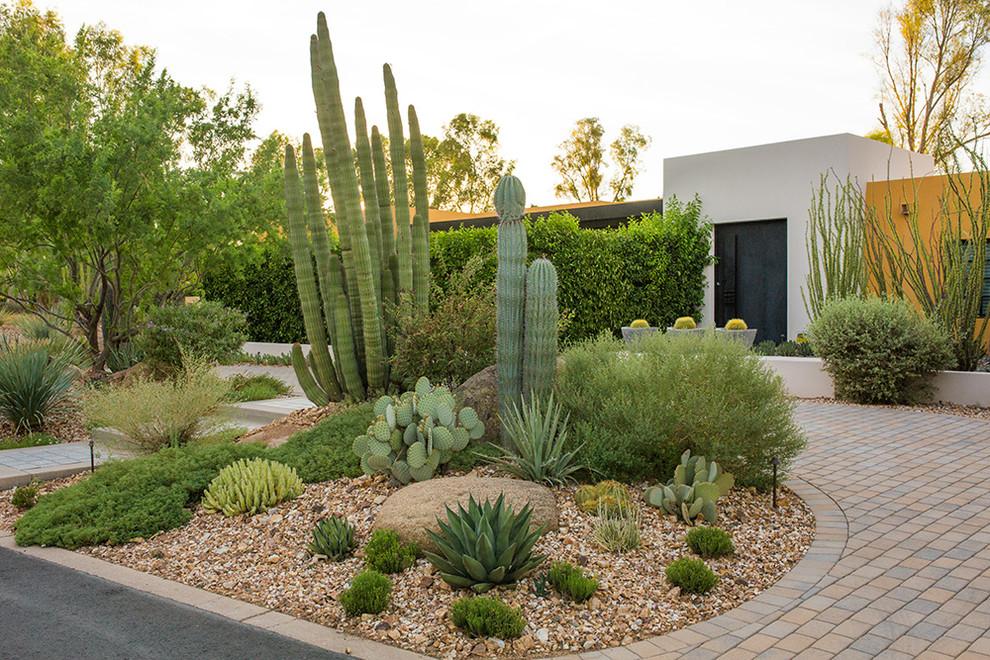
This bed proves you can pack in a lot of texture without it looking messy. Organ pipe cactus and saguaro rise up top, prickly pear spreads in the middle, and low succulents fill the front edge.
The layering matters here. Tall spiky plants sit behind rounder, softer shapes, so your eye keeps moving through the bed instead of stopping flat.
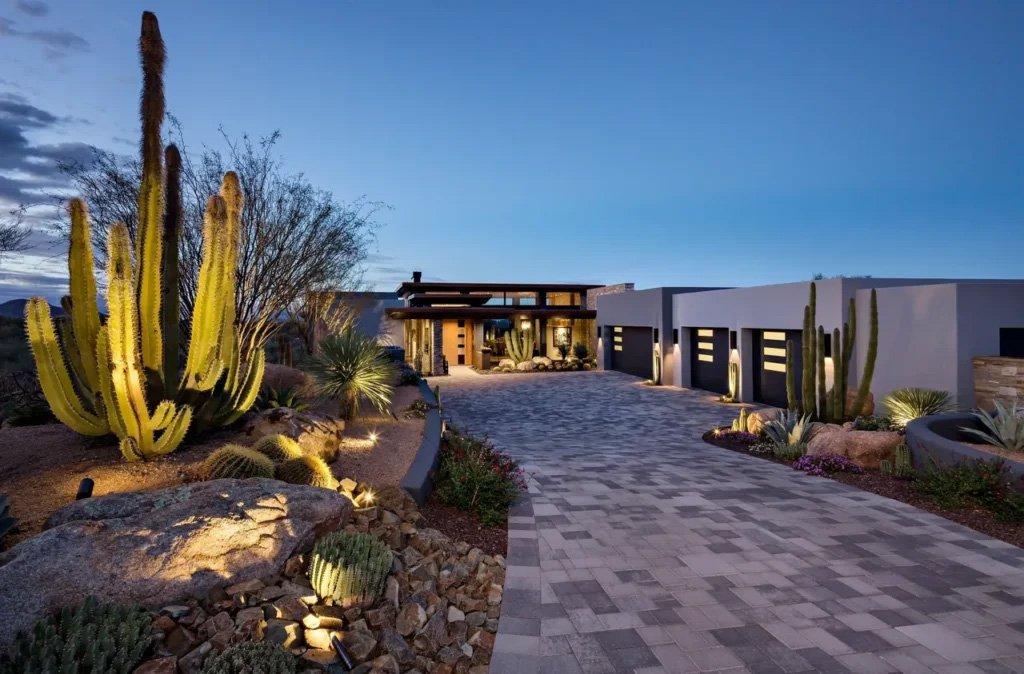
A curved paver driveway wraps around the planting, which helps frame it like an actual garden feature rather than an afterthought near the entrance.
Multiple rock sizes, from pea gravel to a large boulder, add even more texture underfoot. Nothing about this bed reads as flat or empty.
If you want a front yard that feels lush despite using almost no water, this is the layout to copy. Just give each plant room to reach full size.
Best for: Modern desert homes, statement entryways
Maintenance: Low
Cost range: Mid to high
Pairs well with: Organ pipe cactus, prickly pear, agave, mixed gravel
4. Saguaro and Golden Barrel Cactus Cluster
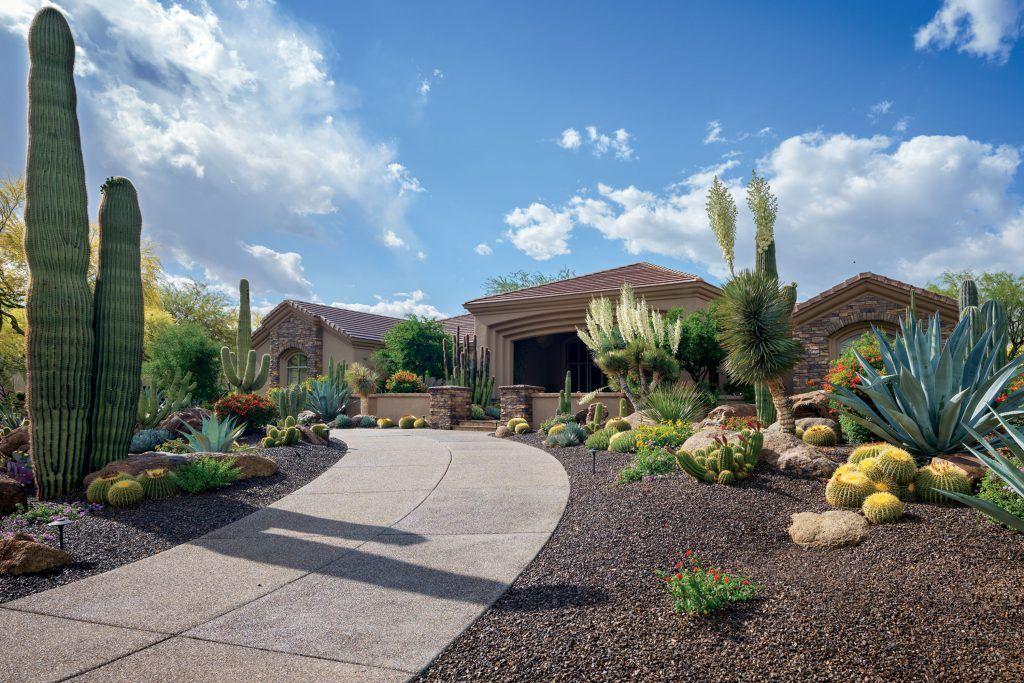
If you want a yard that stops people on the sidewalk, this is it. Towering saguaros anchor the space, while a cluster of golden barrel cactus glows against dark lava rock.
The color contrast does a lot of the work. Golden spines against black rock pop in a way gravel alone never would.
Yucca and red-flowering perennials break up the green and add seasonal color. Even in a mostly cactus yard, you still get pops of red and gold through the year.
A curving concrete driveway gives the whole layout room to breathe. The plants don’t feel crowded, and the house stays visible instead of hidden behind greenery.
This idea takes patience since saguaros grow slowly. But if you’re planting for the long term, nothing else says “Arizona” quite like it.
Best for: Large lots, statement front yards
Maintenance: Low
Cost range: High (mature saguaros are pricey)
Pairs well with: Golden barrel cactus, yucca, lava rock mulch
5. Minimalist Boulder and Gravel Xeriscape
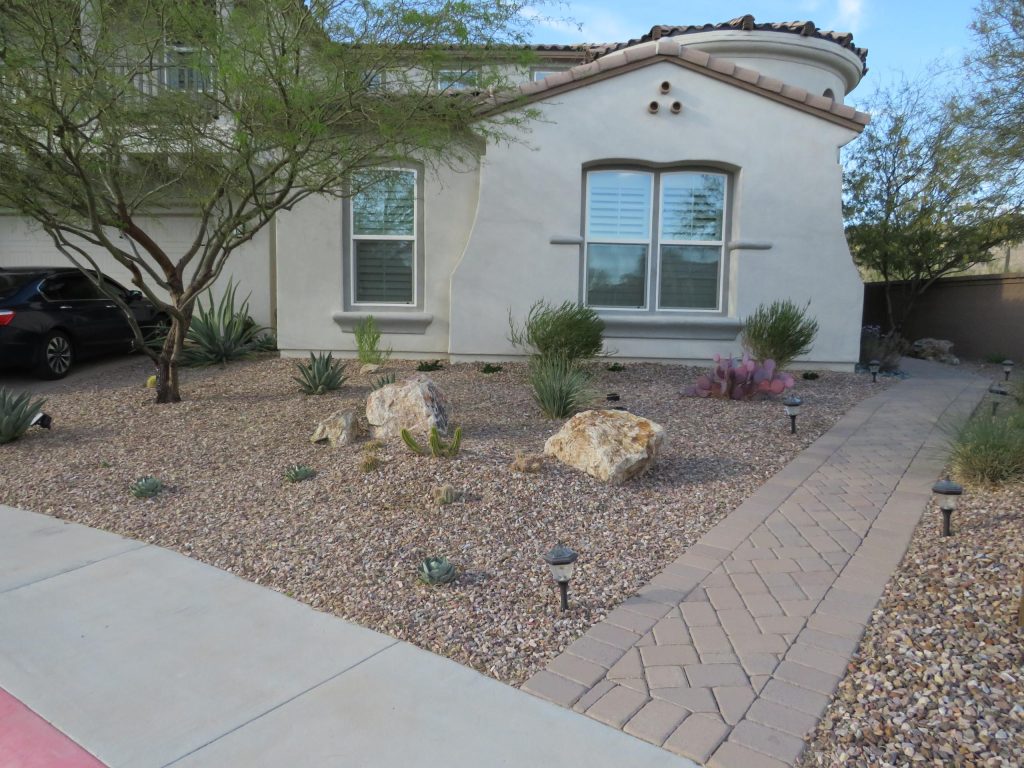
This one is proof that less really can be more. A handful of agave plants and two large boulders sit in a bed of light gravel, and that’s basically it.
I like how much breathing room this gives the yard. Nothing competes for attention, so each plant and boulder actually gets noticed.
Small landscape lights line the path, which makes the space feel finished even with so few elements. At night, the lighting alone carries the design.
A paver walkway edges the bed and keeps the layout crisp. Straight lines against organic boulders and spiky agave create a nice push and pull.
If you want the lowest-maintenance option on this whole list, start here. Once the agave establishes, you’re basically just sweeping the walkway.
Best for: New builds, low-maintenance seekers
Maintenance: Very low
Cost range: Budget
Pairs well with: Agave, boulders, landscape lighting, pavers
6. Desert Wildflower Meadow
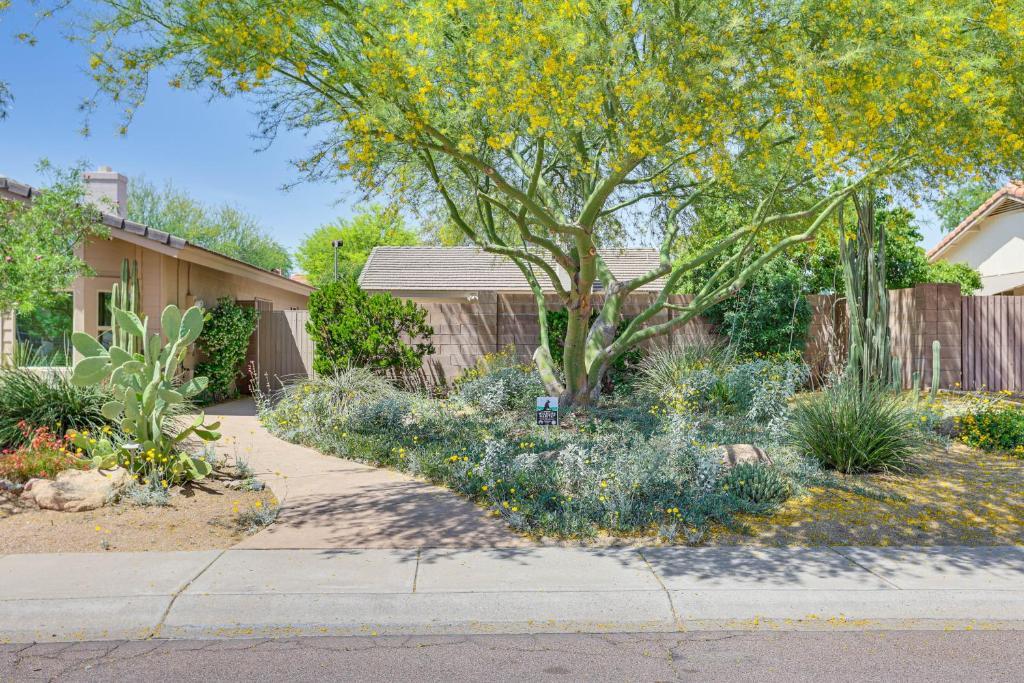
Not every Arizona yard has to look like a rock garden. This one leans soft, with a mature palo verde tree shading a bed full of wildflowers, prickly pear, and ocotillo.
Yellow and white blooms scatter through the bed in a way that feels natural, not planted in rows. It’s the closest thing to a cottage garden you’ll get in a desert climate.
The palo verde’s yellow flowers echo the wildflowers below, tying the whole scene together. Even the fence line disappears behind the plant growth.
This layout takes more patience to establish than a gravel bed. Wildflowers need a season or two to fill in fully.
But once it’s going, you get color and movement most desert yards skip entirely. If you miss a traditional garden feel, this idea gets you close without the water bill.
Best for: Yards with mature trees, cottage-style homes
Maintenance: Medium
Cost range: Budget to mid
Pairs well with: Palo verde trees, ocotillo, prickly pear, native wildflower mix
7. Spanish Mission Courtyard Entrance
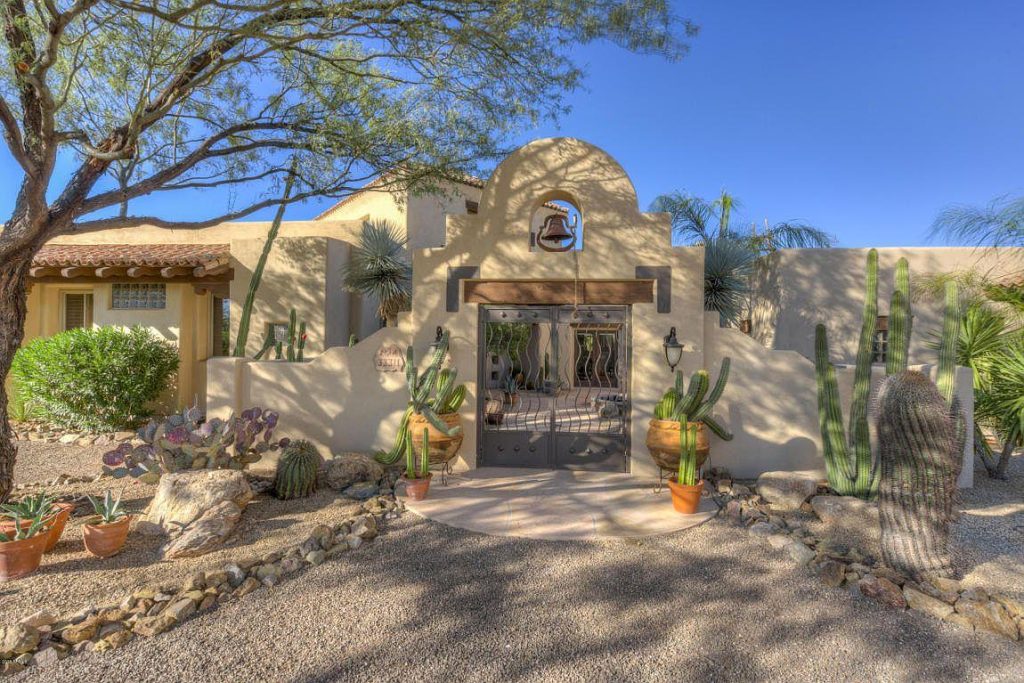
This entrance feels more like a destination than a front door. A curved stucco archway frames the entry, with a bell mounted right at the top.
Potted saguaros flank the iron gate. I like how the pots keep them tidy and portable, unlike planting straight in the ground.
Prickly pear and agave fill the beds along the wall’s base. River rock edges the whole planting, which keeps everything neat without needing a hard border.
Taller cactus and yucca rise near the wall, adding height that pulls your eye up toward the bell and arch.
This idea works best on homes that already lean Spanish or Mission style. The archway does a lot of the design work here, so your plants just need to support it, not compete with it.
If your home has that same stucco-and-tile look, this entrance treatment turns a plain front door into something people actually stop and photograph.
Best for: Spanish or Mission-style homes
Maintenance: Low
Cost range: Mid to high (hardscaping adds cost)
Pairs well with: Potted saguaro, prickly pear, river rock, agave
8. Adobe Courtyard with Lit Pathway
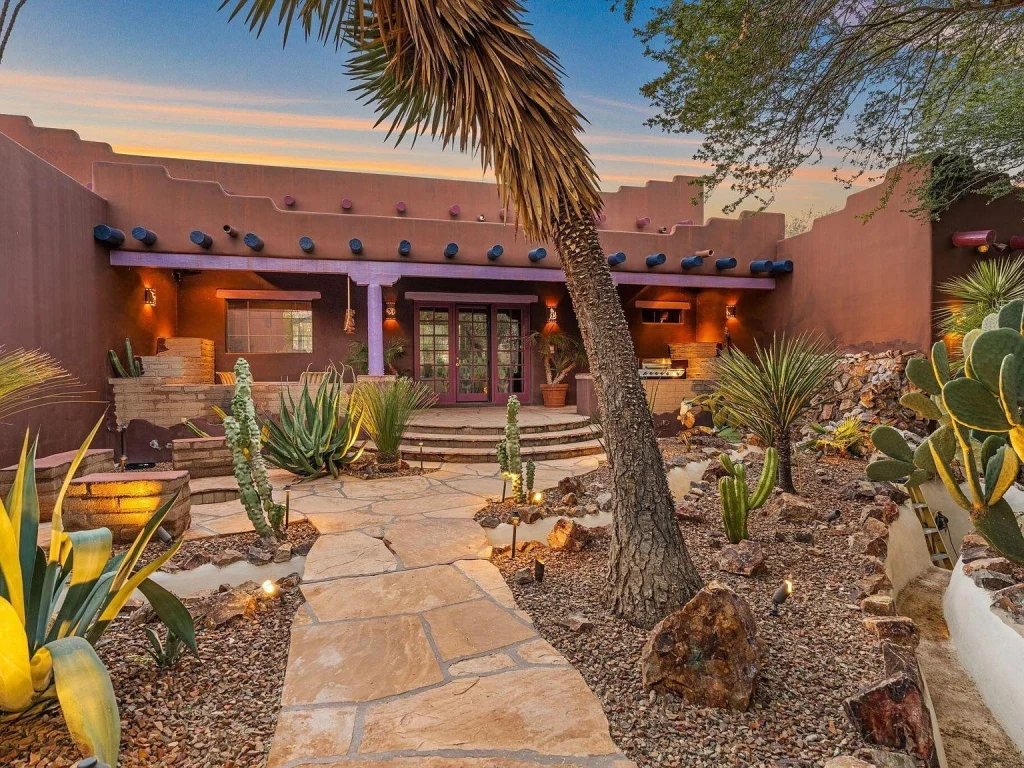
At night, this yard turns into something else entirely. Warm lighting along the flagstone path makes the cactus and agave glow from below.
I love how the lighting does double duty here. It’s practical for walking after dark, and it turns ordinary plants into the main event.
Agave, aloe, and organ pipe cactus line the path in loose, natural groupings. Nothing feels rigid or overly planned, which keeps the desert look authentic.
Boulders and volcanic rock break up the flagstone, adding rough texture next to the smooth stone. The mix keeps your eye moving.
A mature tree arches over the entry, softening all those hard desert edges with a bit of shade and movement.
This idea takes more upfront investment than a basic gravel yard. Path lighting and flagstone aren’t cheap.
But if you want a front yard that works day and night, this is the one to copy.
Best for: Adobe or pueblo-style homes, evening curb appeal
Maintenance: Low to medium
Cost range: High
Pairs well with: Agave, aloe, organ pipe cactus, flagstone, path lighting
9. Ornamental Grass and Lavender Border
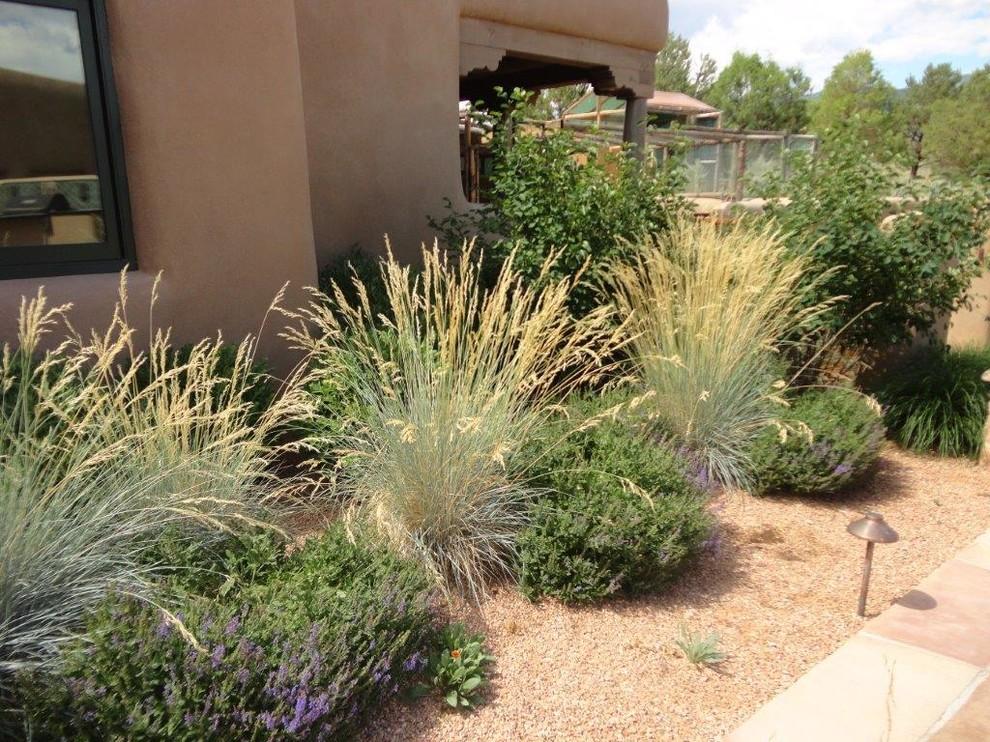
Not every Arizona yard needs cactus front and center. This border leans on movement instead, with feather-like ornamental grasses swaying above mounds of lavender.
I really like how the grass catches light. Even a light breeze sets the whole bed in motion, which gravel and boulders can’t do.
Lavender fills in beneath the grasses, adding purple color and a soft, rounded shape that balances all that upright texture.
Small rock mulch keeps weeds down and moisture in, without pulling focus from the plants themselves.
This idea suits homeowners who want a garden feel without a thirsty lawn. Both grasses and lavender handle heat well once established, and neither needs constant babying.
If you like the idea of a yard that moves and smells good near the front door, this border delivers both.
Best for: Cottage or transitional-style homes
Maintenance: Low to medium
Cost range: Budget to mid
Pairs well with: Ornamental grasses, lavender, rock mulch, path lighting
10. Boulder and Wildflower Rock Garden
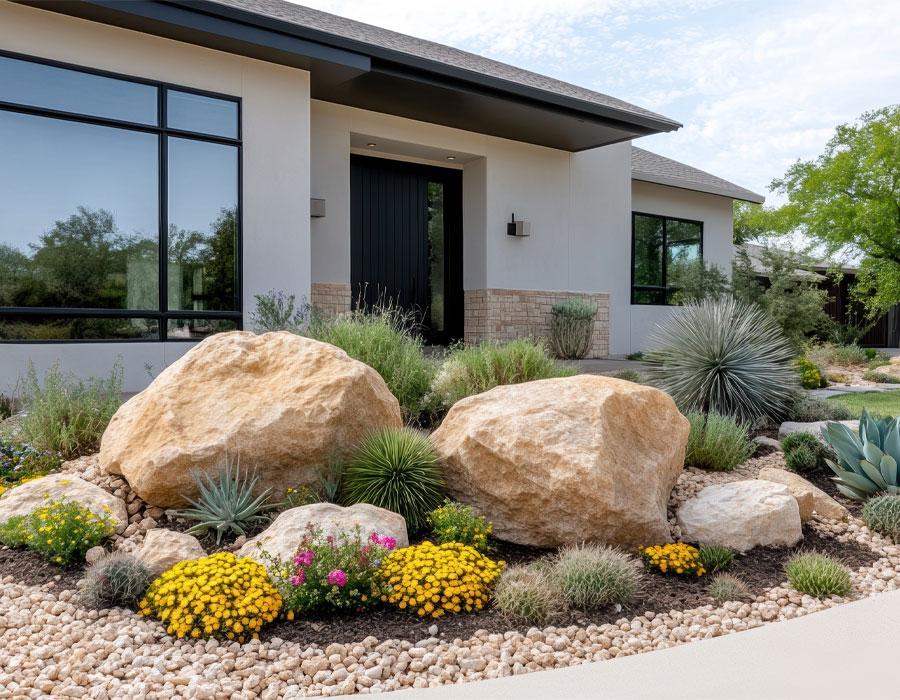
This bed proves boulders and color aren’t opposites. Two massive tan boulders anchor the space, while yellow and pink wildflowers spill out around their base.
I like how the scale plays out here. Oversized rocks next to small, delicate flowers create real contrast, and neither one gets lost.
Yucca and agave add spiky structure between the boulders, so the bed doesn’t read as purely soft or purely hard.
Two-tone gravel, cream and tan, wraps around the planting and ties back to the boulder color. It’s a small detail, but it makes the whole bed feel planned.
This layout works especially well for modern homes with clean architectural lines. The boulders echo that same solid, minimal feel, while the wildflowers keep it from looking cold.
If you want drama without going full cactus garden, this is a strong middle ground.
Best for: Modern homes, contrast-driven designs
Maintenance: Low to medium
Cost range: Mid to high
Pairs well with: Yucca, agave, wildflowers, boulders
11. Dry Creek Bed with River Rock
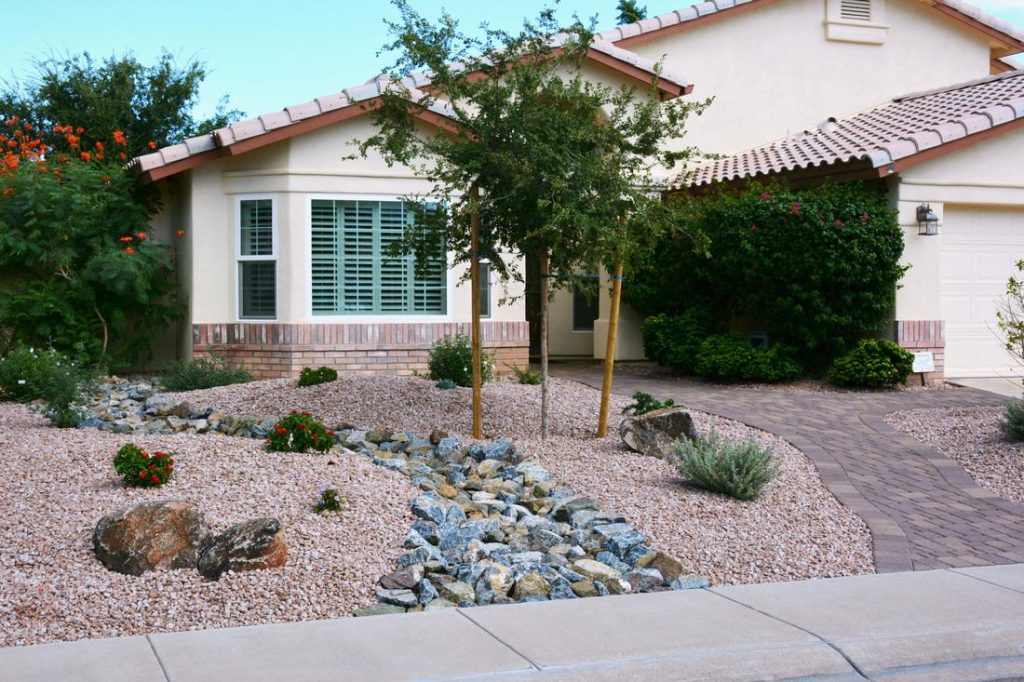
This idea turns a drainage problem into the yard’s best feature. A winding dry creek bed, built from mixed river rock, cuts through the front lawn like a real stream.
I love how natural it looks. The rocks vary in size and color, which keeps the “creek” from looking like a straight gravel strip.
A young tree stands right at the bend, with red and white flowering shrubs planted close by. The color breaks up all that gray and tan stone nicely.
Rounded river rock beds spread out on either side of the creek, softening the transition between hardscape and whatever planting sits nearby.
This works especially well if your yard already has a natural slope or a spot where water pools after rain. Instead of fighting the drainage, you’re building around it.
It’s a practical fix that still looks intentional, not just functional.
Best for: Sloped yards, drainage-prone lots
Maintenance: Low
Cost range: Mid
Pairs well with: Flowering shrubs, young shade trees, river rock
12. Mediterranean Courtyard with Manicured Hedge
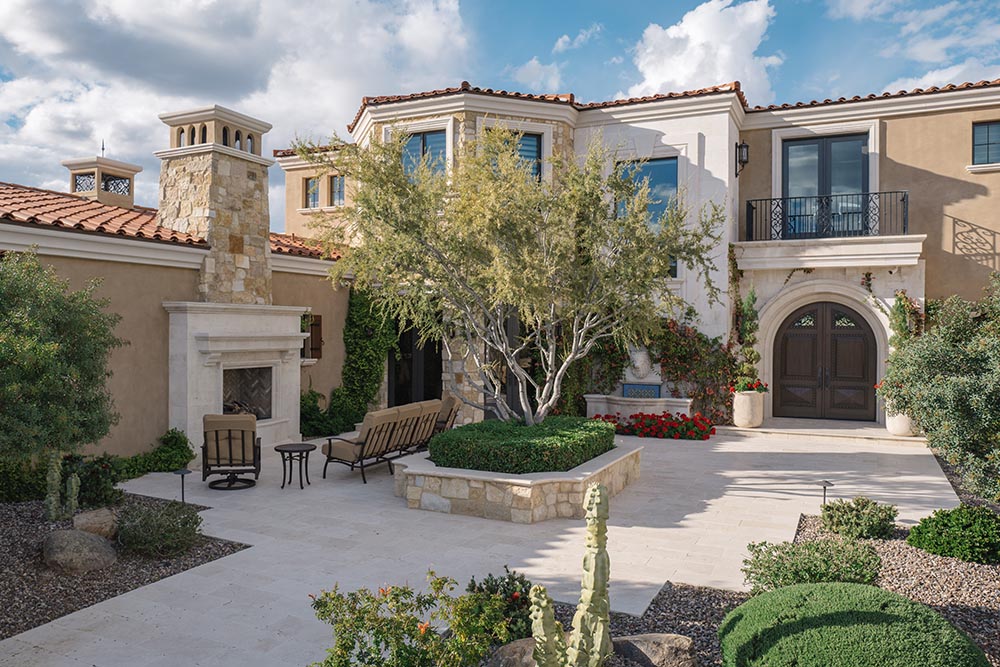
This front yard skips the typical desert look entirely and goes formal instead. A raised stone planter holds a neatly clipped hedge, centered right in the courtyard.
I like how structured this feels compared to the rest of the list. Clean lines, matching stone, and a symmetrical layout give it a European estate feel.
Red geraniums line the planter’s edge, adding a pop of color against all that tan stone and green hedge.
A mature tree rises from the center bed, providing shade over the seating area without blocking the home’s grand entrance.
Cactus and succulents still show up near the edges, which keeps the design grounded in Arizona even with such a formal layout.
This idea takes real budget and upkeep. Hedges need regular trimming, and stone hardscaping isn’t cheap. But if you want a front yard that reads as luxury, this is the template.
Best for: Large estate homes, formal entryways
Maintenance: Medium to high
Cost range: High
Pairs well with: Clipped hedges, geraniums, stone planters, shade trees
Frequently Asked Questions
How much does it cost to convert a front yard to Arizona-style landscaping?
It depends on the size of your yard and how much hardscaping you add. A basic gravel-and-succulent yard can run budget-friendly, while boulders, pavers, and mature saguaros push costs higher.
Most homeowners land somewhere in the mid-range once labor and materials come together.
Do I need a permit to remove my grass in Arizona?
Most cities don’t require a permit just to remove grass. But if you’re adding hardscaping like retaining walls or major drainage changes, check with your local municipality first.
HOAs often have their own rules too, so it’s worth a quick call before you start digging.
What’s the fastest-growing desert plant for a new yard?
Palo verde trees grow fast and give you shade within a few years. Agave and yucca also fill in quickly compared to slow growers like saguaro, which can take decades to reach full height.
If you want quick results, lean on grasses and shrubs while your slower plants catch up.
Can I mix cactus with flowering plants?
Yes, and I’d actually recommend it. Wildflowers, lantana, and flowering shrubs add color without asking for much water.
Just give them their own pocket in the bed so they don’t get shaded out by taller cactus or crowded by spiky plants that need more room to breathe.
How do I keep gravel from shifting or sinking over time?
Lay a weed barrier fabric underneath before you spread gravel. It stops the rock from sinking into the soil and cuts down on weeds pushing through.
Topping it off every few years keeps the bed looking fresh, since sun and foot traffic wear gravel down slowly.
Final Thoughts
You don’t need grass to have a front yard people notice. Some of the best-looking yards in Arizona skip it entirely.
Whether you go bold with saguaros or soft with wildflowers, every idea on this list works with the climate instead of against it.
Pick the style that matches your home, give your plants room to grow, and let the desert do what it does best.