Seed Starting Date Calculator: When to Start Your Seeds Indoors

Not sure when to start your seeds indoors this year? You’re not alone.
Start too early and you end up with leggy, stressed-out seedlings weeks before it’s warm enough to plant them.
Start too late and you lose growing season.
The timing depends on your last spring frost date and how many weeks each plant needs before it can handle the outdoors.
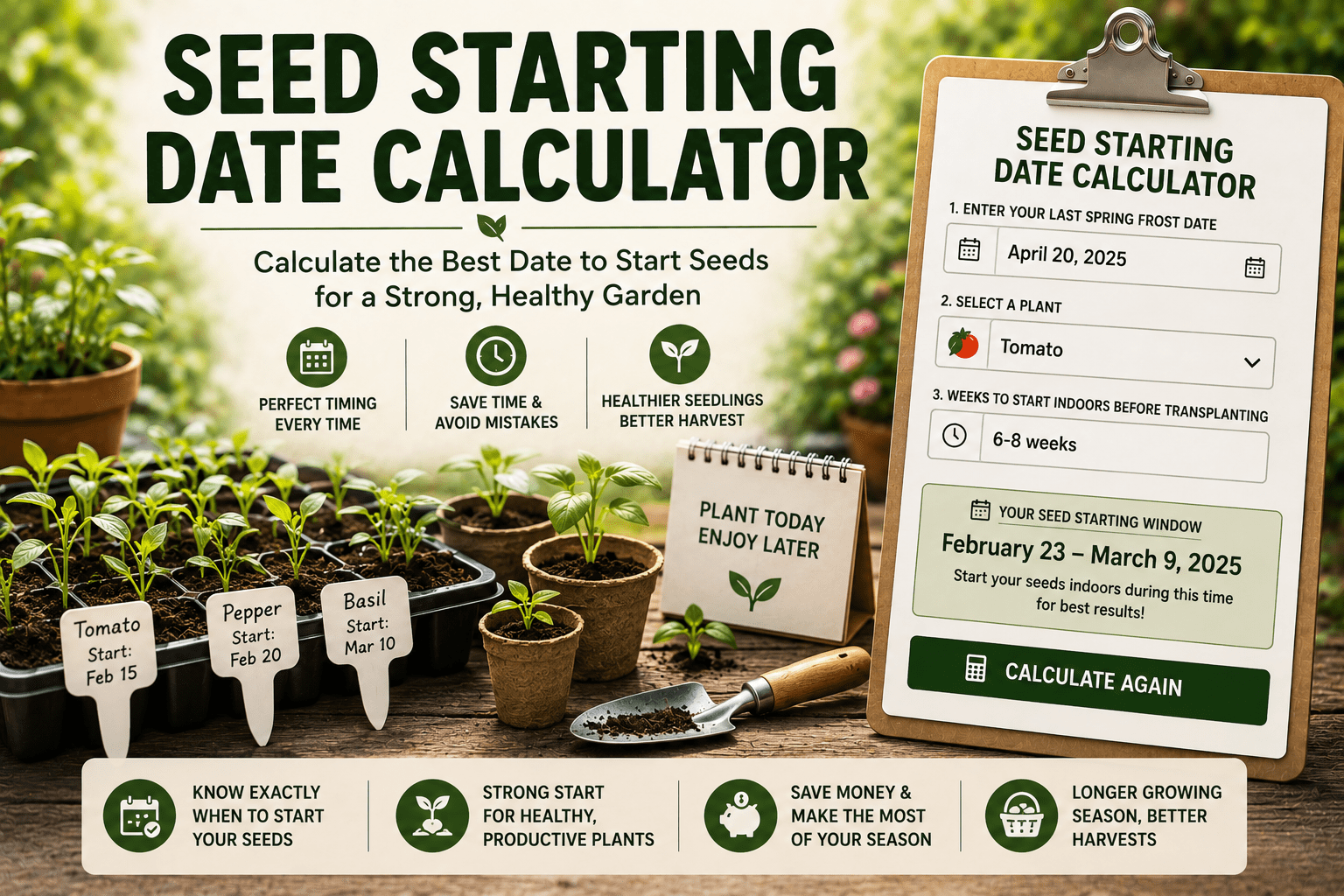
This calculator does that math for you. Enter your frost date, pick a plant, and you’ll get exact date ranges for starting seeds indoors and moving transplants outside.
What Is a Frost Date, and Why Does It Matter?
Your last spring frost date is the average date when the danger of frost has passed in your area. It’s not a guarantee.
It’s a helpful benchmark based on years of local weather data. Every seed-starting schedule works backward from this one date.
You can find your frost date through your local extension office or an online frost date lookup by ZIP code.
Once you know it, you can count back the recommended number of weeks for each plant to figure out your indoor sowing date.
Common Seed Starting Mistakes to Avoid
A few timing mistakes show up again and again in home gardens.
- Starting everything on the same day. Onions, celery, and peppers need a much longer head start than squash or cucumbers. Treating every plant the same way throws your whole season off.
- Ignoring your specific frost date. A calendar date that works for a friend in another state won’t work for you. Local frost dates can vary by weeks even within the same region.
- Skipping the hardening-off period. Seedlings started indoors need about a week of gradual outdoor exposure before you transplant them, so build that into your timeline too.
- Waiting too long on cold-hardy crops. Plants like kale, broccoli, and pansies can go outside before your frost date. Holding them back indoors just makes them leggy for no reason.
Seed Starting Date Calculator
Enter your last spring frost date below, then filter by vegetables, herbs, or flowers to see when to start each one. Enter your average last spring frost date Calculate
Not sure of your frost date? Check the Farmers’ Almanac frost date lookup by ZIP code. AllVegetablesHerbsFlowers
Not sure of your frost date? Check the Farmers’ Almanac frost date lookup by ZIP code.
| Plant | Start Seeds Indoors | Move Outside / Transplant |
|---|---|---|
| Enter your frost date above and hit Calculate to see your planting dates. | ||
* Best direct-sown outdoors, but can also be started indoors if you want a head start.
* Best direct-sown outdoors, but can also be started indoors if you want a head start.
How to Use This Calculator
Using it takes three steps.
- Find your frost date. Use the Farmers’ Almanac link above or check with your local extension office.
- Enter it and hit Calculate. Every plant in the database will update with dates based on your specific frost date.
- Filter or search for what you’re growing. Use the category buttons or the search box to pull up just the plants on your list.
You’ll see two date ranges for each plant: when to start seeds indoors, and when it’s safe to transplant or direct sow outside.
Plants marked with an asterisk grow best when sown directly in the garden, but you can still start them indoors early if you want a jump on the season.
Frequently Asked Questions
What if I don’t know my exact frost date?
Use an online frost date lookup by ZIP code, or ask your local extension office. If you’re between two nearby dates, it’s safer to use the later one.
What if a plant I’m growing isn’t on the list?
Check the seed packet. Most seed packets list the recommended weeks before your last frost date, and you can apply that number the same way this calculator does.
Can I start my seeds too early?
Yes, and it’s one of the most common seed-starting mistakes. Seedlings started too early outgrow their containers, get leggy under indoor light, and struggle once transplanted.
Do I need to follow this schedule exactly?
Treat it as a guide, not a rulebook. Your microclimate, whether you use grow lights, and your local weather in a given year can all shift things by a few days.
What if my frost date changes from year to year?
Frost dates are averages, so the actual last frost will vary each year. Keep an eye on your local forecast as your transplant window approaches, and be ready to cover tender seedlings if a late cold snap shows up.
Final Words
Once you know your frost date, seed starting stops being a guessing game. Plug it into the calculator, jot down your dates for each plant, and you’ll have a clear schedule for the whole season.
A little planning now means stronger seedlings and a garden that’s ready to go the moment it’s warm enough outside.