Tired of Fighting Colorado’s Dry Summers? 12 Drought Tolerant Yards That Work

Colorado weather doesn’t do subtle. One week you’re watering twice a day. The next, a hailstorm flattens everything you just planted.
I get why so many homeowners here are ditching the traditional lawn. Water restrictions keep tightening. Clay soil fights you at every turn.
And let’s be honest, nobody wants to mow every weekend just to watch the grass go brown by August anyway.
Drought tolerant landscaping flips the whole problem around. Instead of fighting Colorado’s climate, you work with it. Native grasses. Boulders. Wildflower meadows. Dry creek beds that double as drainage fixes.
These 12 real Colorado yards show just how many directions you can take it. Some go bold with rock gardens. Others keep it soft with layered perennials. Pick the style that fits your space, and let’s get into it.
Why Colorado Yards Are Made for Drought Tolerant Design
- Start with your water bill: Front Range cities restrict watering days every summer. A drought tolerant yard barely notices the rules, so you’re not scrambling every July.
- Work with your soil, not against it: Colorado’s clay and rocky soil frustrates thirsty plants. Natives and xeriscape varieties actually prefer it.
- Plan for altitude and sun: High elevation means intense UV and big temperature swings. Drought tolerant plants shrug both off, while a traditional lawn scorches.
- Add one bold feature: A dry creek bed, a boulder cluster, or a wildflower meadow gives your yard a personality lawns just can’t match.
I’ve noticed the yards that get pinned and shared the most all do one thing well. They pick a strong feature and build around it. You don’t need every idea from this list. Pick the one or two that fit your space, and let them lead.
12 Drought Tolerant Landscape Ideas for Colorado Yards
1. Prairie-Style Entry Garden with Black-Eyed Susans
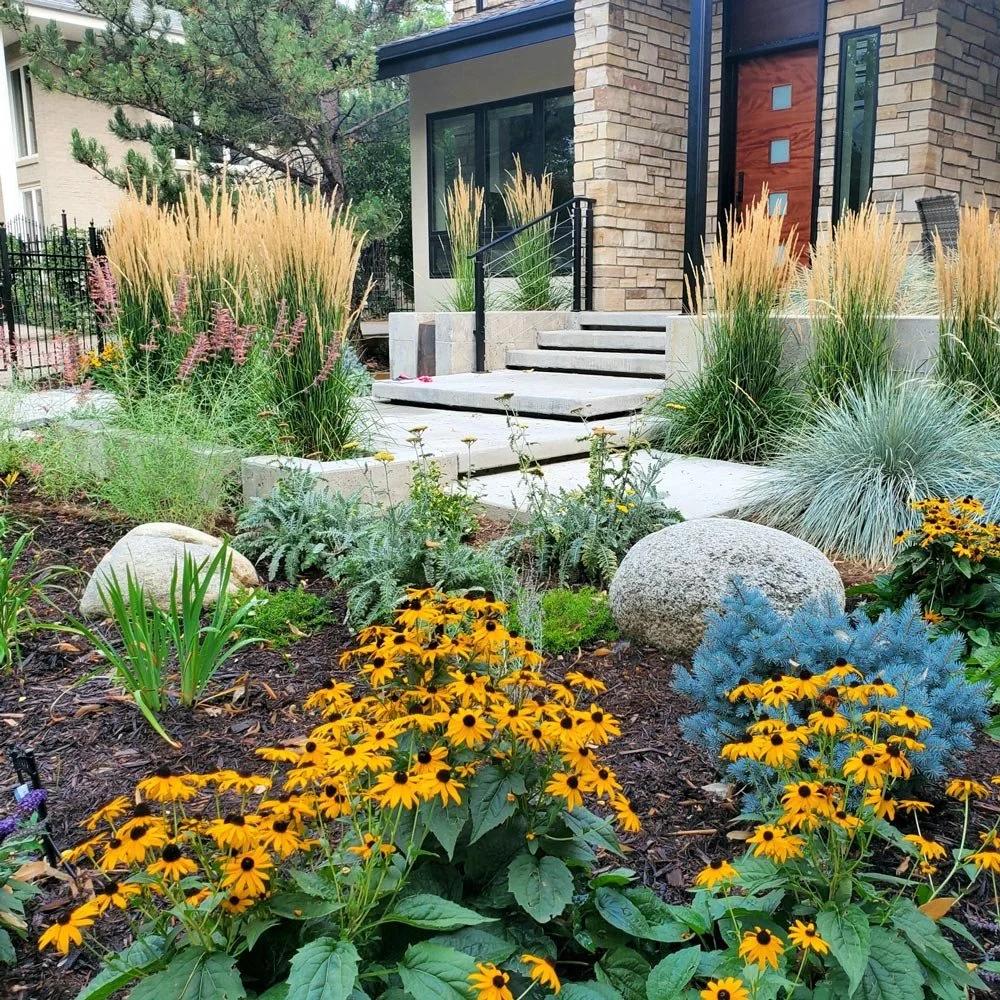
This front entry proves you don’t need a lawn to feel welcoming. Golden Black-Eyed Susans spill over the path in loose, natural drifts. Feather reed grass shoots up behind them, catching the light with tan plumes.
A blue spruce accent and smooth granite boulders add year-round structure once the flowers fade.
Why it works:
- The mix of heights (low flowers, mid grasses, tall spruce) gives the bed real depth
- Boulders break up the planting so it never looks like one big blob of color
- Black-Eyed Susans bloom for months and shrug off Colorado’s dry summers
Water-wise tip: Group plants by thirst level. Keep the Rudbeckia and grasses on the same drip zone, and give the spruce its own slower-draining line so you’re not overwatering one to satisfy the other.
Best for: A front yard with existing hardscape steps or a modern stone facade that needs softening.
2. Sloped Xeriscape Yard with Silver Foliage and Boulders
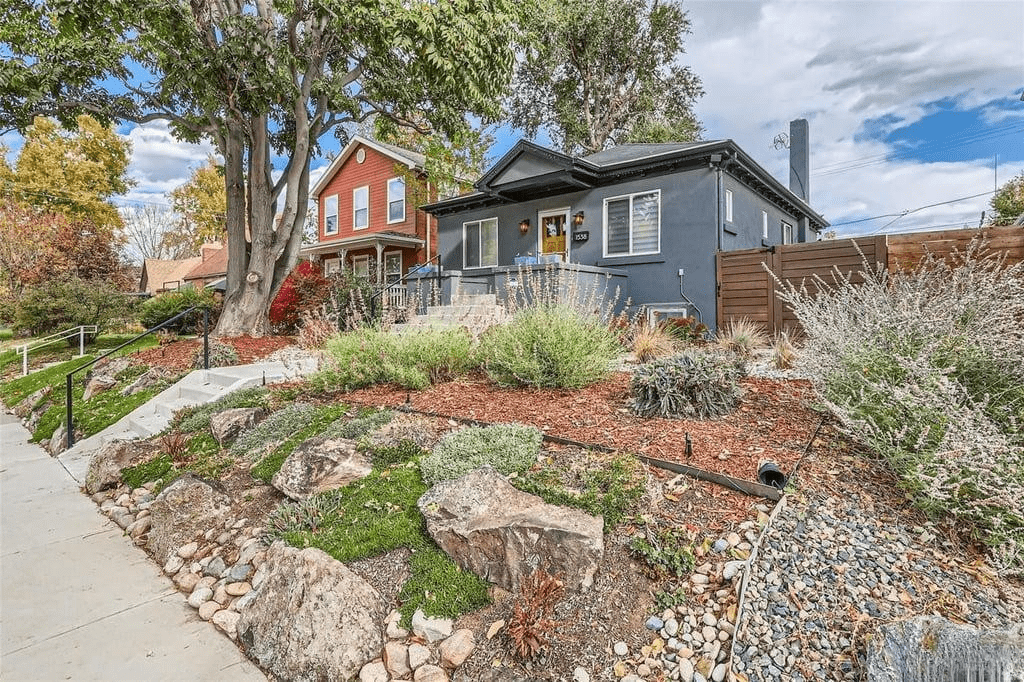
A sloped yard is usually a headache. This one turns the slope into an asset. Silvery Russian sage and artemisia tumble down the hill next to gravel mulch, with a few well-placed boulders holding the grade in place.
A mature shade tree up top keeps the whole scene from feeling too stark.
Design formula: silver-foliage shrubs + gravel mulch + weathered boulders + one anchor tree
Landscape note: Slopes shed water fast, so plant your thirstiest specimens near the bottom where runoff collects, and save the driest, toughest plants for the crest.
Maintenance note: This kind of planting basically maintains itself. You’re looking at an occasional trim in spring and maybe topping off the gravel every couple of years. No mowing, no weekly watering schedule.
I like this one for anyone who’s tired of fighting a slope with grass that keeps sliding down the hill.
3. Backyard Dry Creek Bed with Pines and a Patio
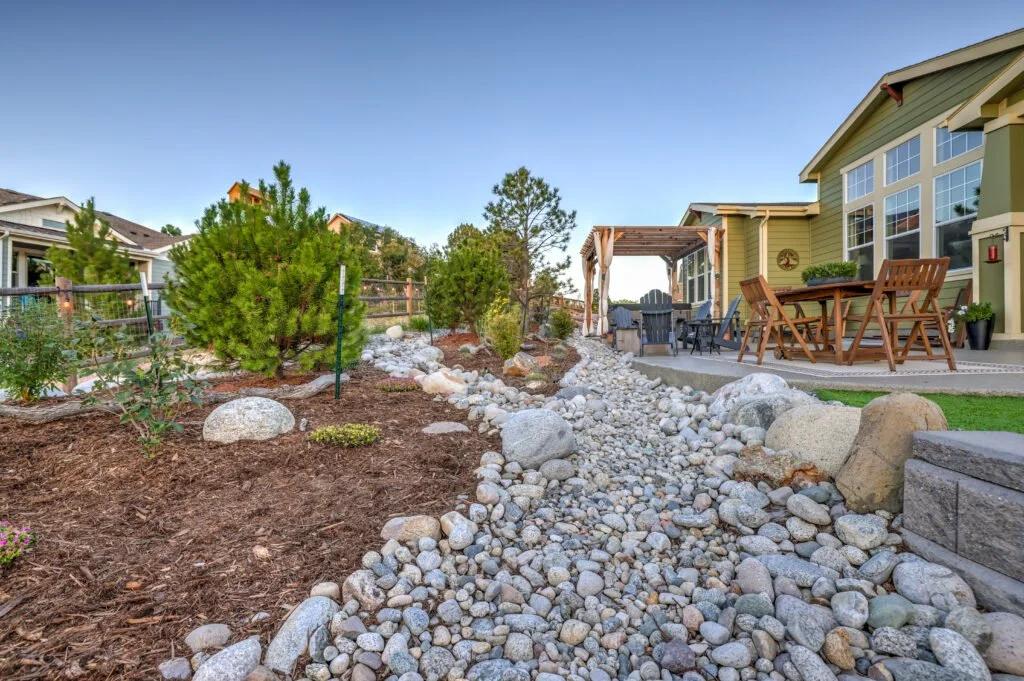
A dry creek bed isn’t just decoration. It’s a drainage solution dressed up to look intentional.
Here, river rock winds through the yard, tucked between young pines and low shrubs, and leads right up to a patio with a pergola. It solves a runoff problem while giving the yard a natural focal point.
Why it works: The curve of the rock bed mimics a real stream, so your eye follows it instead of stopping at a flat lawn edge.
Water-wise tip: Line the channel with landscape fabric before adding rock. It stops weeds from pushing through and keeps the stones from sinking into the soil over time.
Upgrade idea: Add a few larger boulders as “stepping” accents along the bed, then tuck solar path lights nearby. At dusk, the whole channel glows without needing any wiring.
If your yard collects water after a storm, this idea does double duty. You get better drainage and a much better-looking backyard.
4. Feather Reed Grass Border Along the Sidewalk
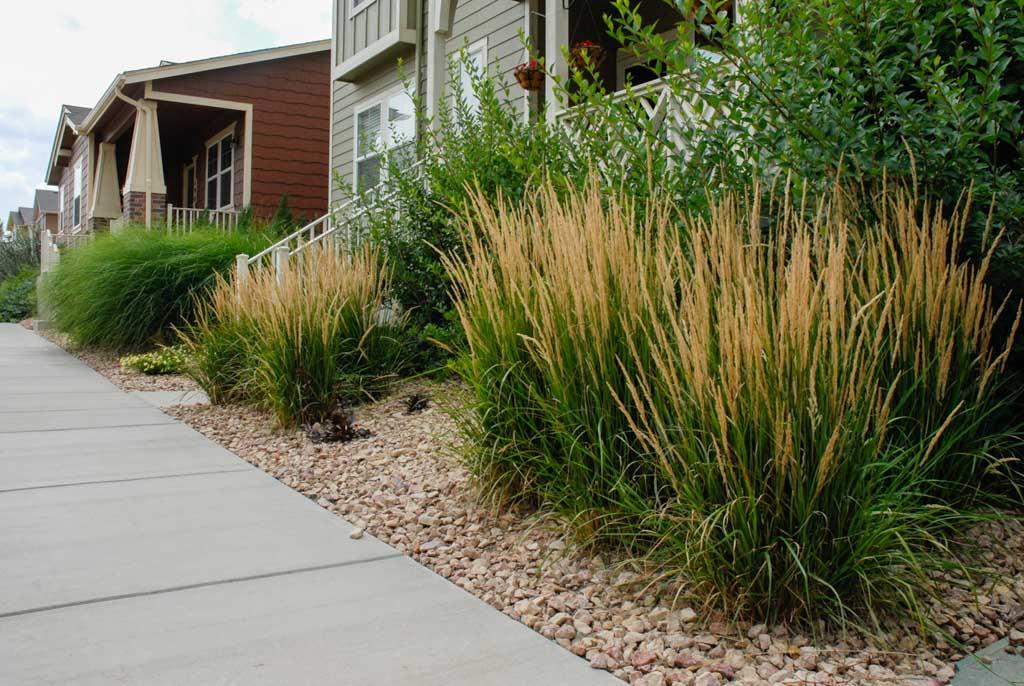
You don’t need a huge yard to go drought tolerant. This narrow strip between the sidewalk and the house proves it.
Karl Foerster feather reed grass lines up in a tidy row, planted straight into pea gravel with no grass strip at all. It’s simple, but it looks sharp from every angle.
Design formula: one grass variety, repeated + gravel bed + clean edge line
Best for: Townhomes, HOA-regulated front strips, or any narrow side yard where a full garden bed feels like overkill.
What to avoid: Don’t crowd the grasses too close together. Feather reed grass gets wide at the base as it matures, and packing them tight means you’ll be dividing clumps within a couple of years.
I love this one because it’s low-effort but never looks boring. The grass plumes catch the wind and move, so even a plain strip gets some life to it.
5. Wildflower Meadow Front Yard (No-Mow Lawn Alternative)
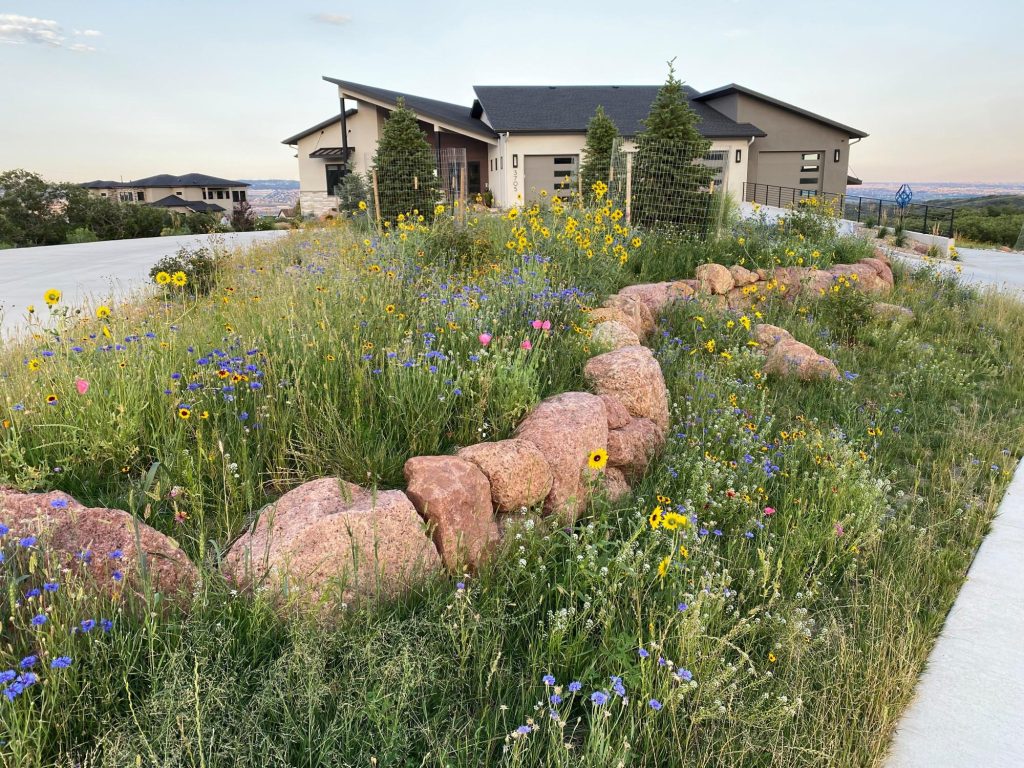
If mowing feels pointless in a dry climate, this is your answer. This entire front yard is a wildflower meadow, packed with sunflowers, cornflowers, and poppies, with a low stacked-stone border keeping it from looking wild and unplanned.
Young evergreens grow in wire cages, protected until they’re established.
Why it works:
- The stone border gives the meadow a clear edge, so it reads as designed, not neglected
- Mixed bloom times mean color from early summer through fall
- Native wildflowers support bees and butterflies without any extra effort from you
Cold-hardy note: Stick to a native Colorado wildflower seed mix built for zone 4-6. These varieties are used to dry summers and hard winters, so they come back reliably year after year.
Maintenance note: One mow in late fall, after seed heads have dropped, is basically all this yard needs. Compare that to weekly mowing on a traditional lawn.
This is the boldest option on the list, but it’s also the one that saves the most water.
6. Boulder Rock Garden with Stone Staircase Entry
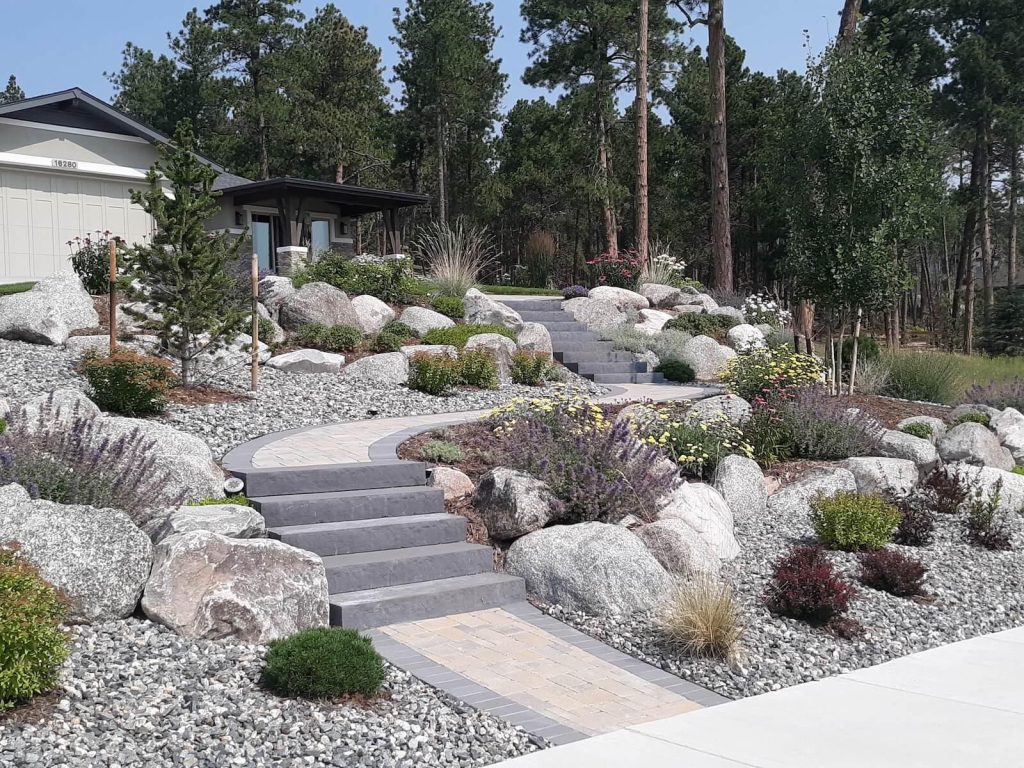
This is xeriscaping at its most dramatic. Massive granite boulders anchor a hillside planted with catmint, ornamental grasses, and dark-leaved barberry, all tied together by a paver staircase that curves up through the garden.
Crushed gravel fills every gap, so there’s no bare dirt and almost no weeding.
Landscape note: Use boulders in odd-numbered clusters (three, five, seven) rather than spacing them evenly. It looks more like something nature placed there over centuries.
Design formula: large boulders + gravel groundcover + drought-tolerant perennials in pockets + a stone or paver path
Upgrade idea: Tuck low-voltage path lights along the staircase edge. On a rock-heavy slope like this, lighting does double duty. It’s safer to walk at night and makes the boulders look even more sculptural.
If your yard has any kind of grade change, this idea turns what could be a liability into the best-looking feature on the block.
7. Modern Front Yard with Sedum Beds and a Stepping-Stone Path
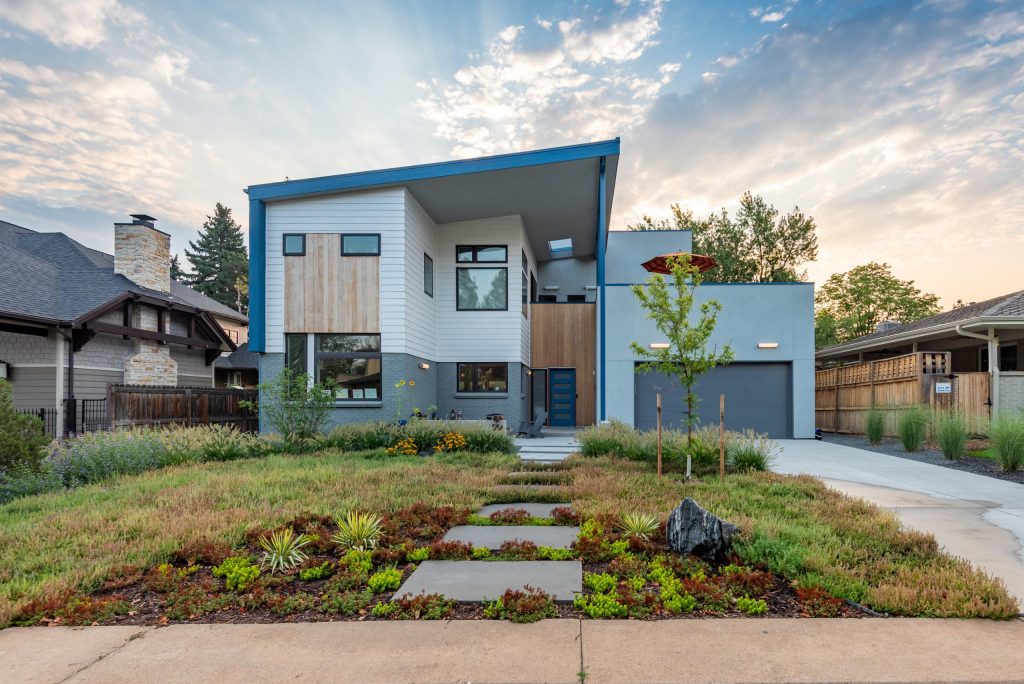
This modern build swaps the classic front lawn for something far more interesting.
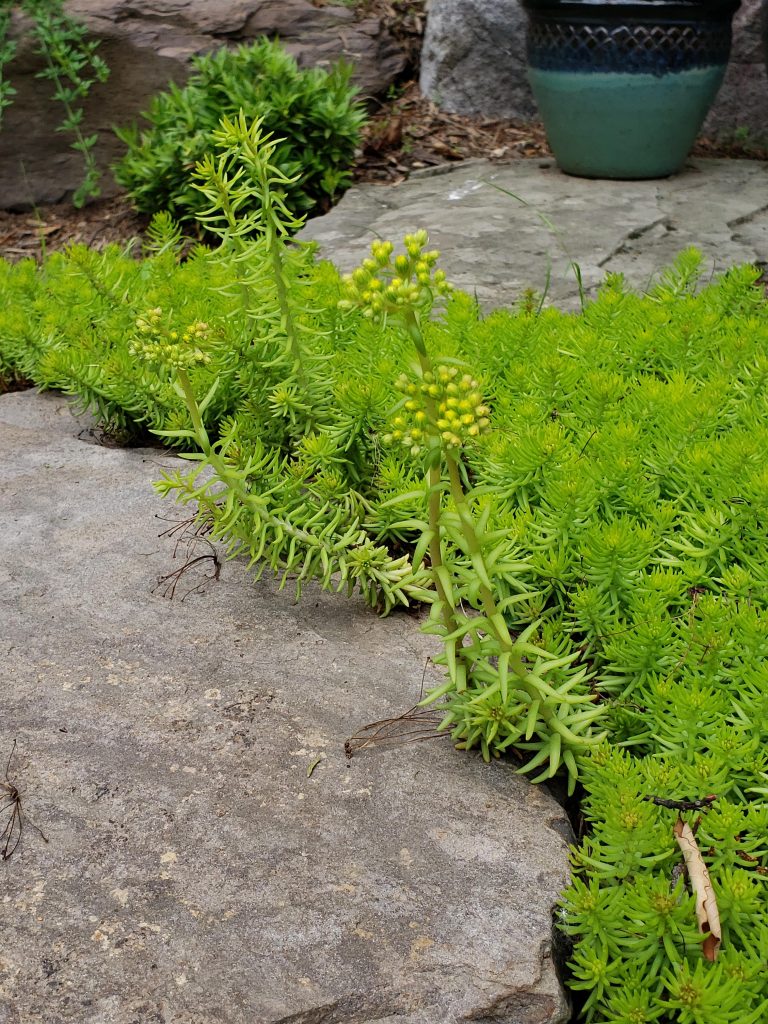
Low-growing sedum and native grass fill in around a stepping-stone path, with clumps of spiky yucca and a single dark boulder for contrast.
The result reads soft and green from a distance, but it barely drinks any water.
Why it works:
- Sedum spreads into a thick mat, so it crowds out weeds on its own
- The stepping-stone path keeps foot traffic off the planted areas
- Mixing textures (spiky yucca next to soft sedum) keeps a simple palette from looking flat
Design formula: low sedum groundcover + concrete stepping stones + a few sculptural succulents + one boulder accent
Best for: New construction or modern homes where you want a lawn-alternative that still feels lush, not just rocky.
I’d point to this one if a client says they want “green” but not grass. It’s proof you can have both.
8. Dry Creek Xeriscape Bed with a Mountain Backdrop
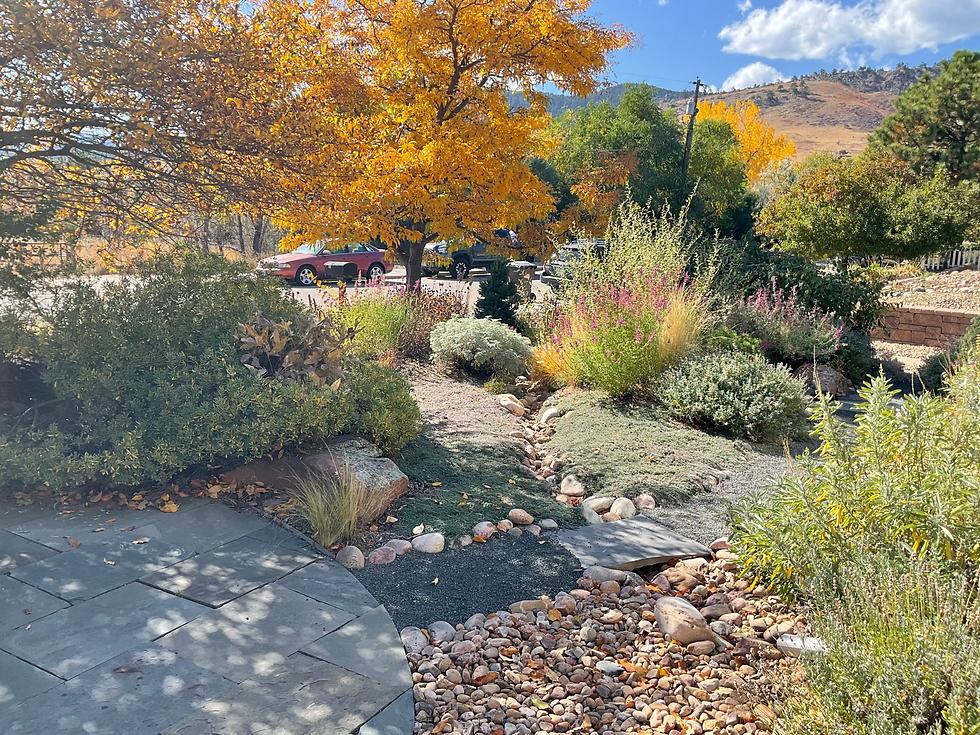
Some yards get to borrow their view, and this one uses it well.
A river-rock dry creek curves through silver artemisia and feathery grasses, with hot-pink Russian sage spikes adding contrast. The foothills rising behind the yard do half the design work for you.
Landscape note: When you’ve got a natural backdrop like this, keep your plant palette muted. Silver and green foliage won’t compete with the view the way bright, busy colors would.
Water-wise tip: Dry creek beds like this one aren’t just pretty. They channel snowmelt and rainstorm runoff away from your foundation instead of letting it pool.
Upgrade idea: Add a flagstone patio at one end of the creek bed, close to the house. It gives you a spot to sit and actually enjoy the mountain view instead of just looking at it from a window.
This idea works best on a property backing up to open space, but even a distant tree line can play the same role.
9. Cottage-Style Xeriscape Yard with Layered Perennials
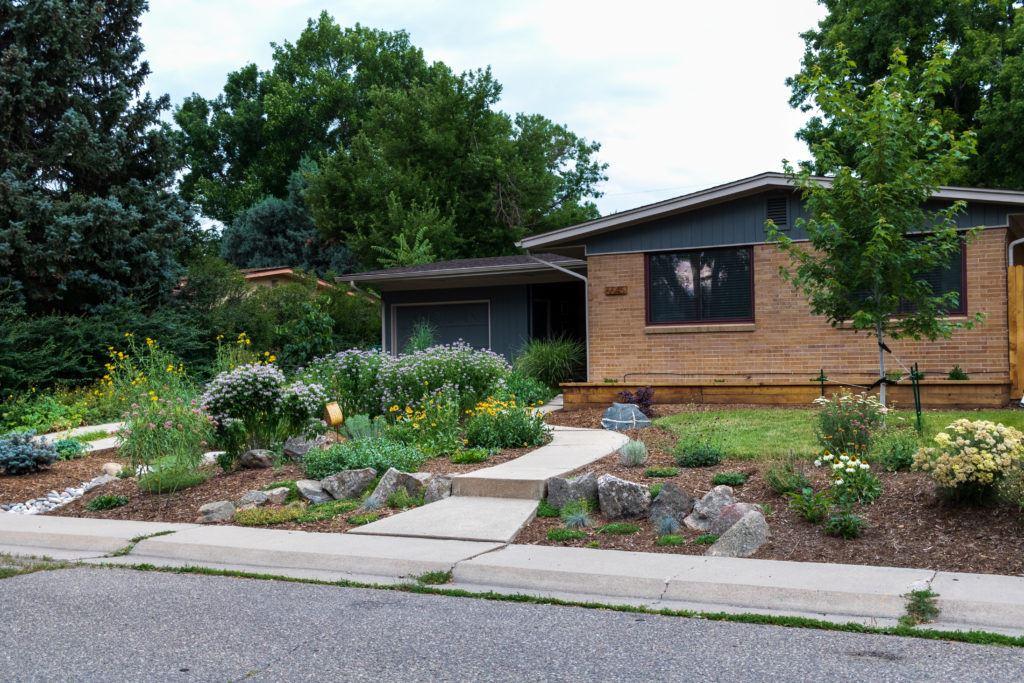
This one breaks the stereotype that drought tolerant means rocks and gravel. Asters, black-eyed susans, and yarrow spill together in loose, romantic drifts, tucked around a curved concrete path.
Boulders and a few evergreens hold the structure while the flowers do the talking.
Why it works: Dense planting shades the soil, which cuts down on evaporation and keeps weeds from getting a foothold, so it uses less water than you’d expect from a bed this full.
Best for: Anyone who loves a classic cottage garden look but wants to cut their water bill.
Maintenance note: Deadhead spent blooms through summer to keep the show going, then leave the seed heads standing in fall. Birds will thank you, and the bed still looks intentional through winter.
What to avoid: Don’t skip a mulch layer here. With this many plants packed together, exposed soil dries out fast between waterings.
If you only take one idea from this list, this is the one to convince skeptical neighbors that drought tolerant can still look like a real garden.
10. Rounded Perennial Island Bed with a Brick Border
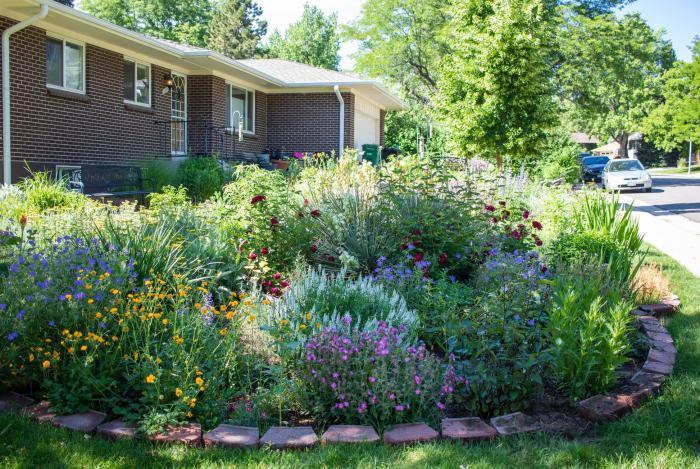
This front yard keeps a small strip of lawn but hands most of the space over to one big, brick-edged island bed.
Salvia, coreopsis, poppies, and tall spires of larkspur all crowd together in a rounded shape that mirrors the curve of the driveway. It’s full, it’s colorful, and it barely touches the sprinkler system.
Design formula: one large curved bed + a brick or stone edge + layered perennials in mixed heights + a thin lawn buffer left around it
Best for: Homeowners who aren’t ready to lose the lawn entirely but want to shrink it down to something more manageable.
Upgrade idea: Swap the brick edging for the same material as your front walkway or driveway. Matching the hardscape ties the bed back into the rest of the property instead of leaving it looking like a separate project.
I like this approach for anyone easing into xeriscaping.
You get all the color and water savings of a big perennial bed, but the strip of lawn out front keeps the yard feeling familiar to neighbors used to traditional landscaping.
11. Layered Dry Creek Bed with Mixed Mulch Zones
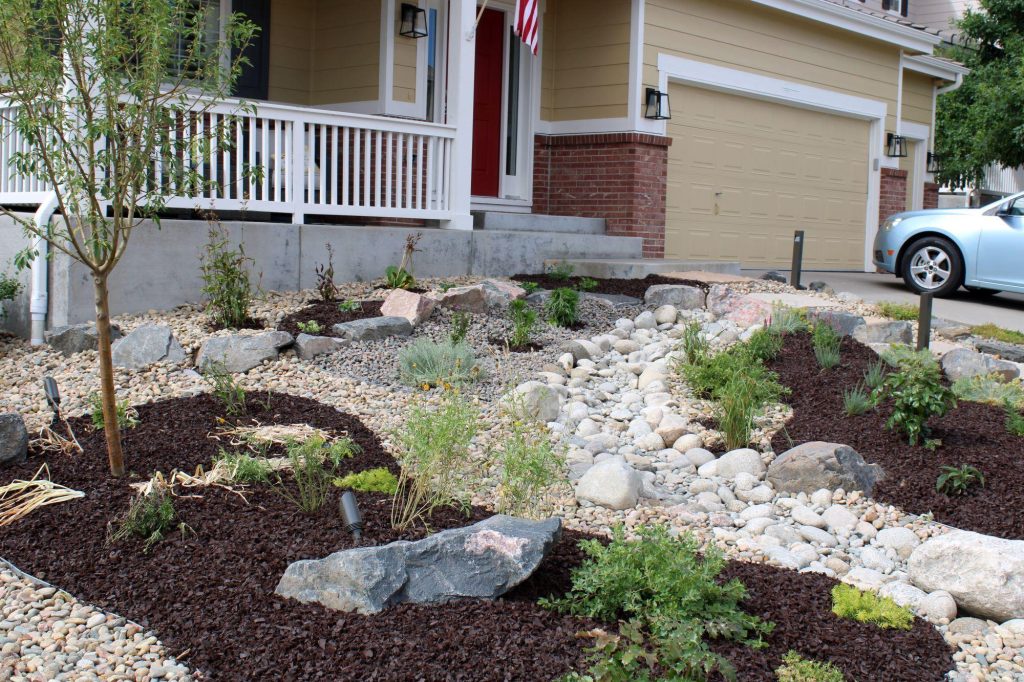
This front yard treats mulch like a design tool, not an afterthought. Dark rubber mulch, gray river rock, and pale pebbles all sit in their own zones, separated by clean curves and anchored with boulders.
A young tree and a few perennials are still filling in, but the bones are already strong.
Design formula: dark mulch borders + a central river-rock “stream” + boulder clusters + young trees for future shade
Landscape note: Curved zone lines like these make a flat front yard feel like it has movement, even before the plants fully mature.
Water-wise tip: Group your rock and mulch zones so the deepest rock sits over the driest, best-draining spot in the yard. Save any low or damp corner for actual plants, since gravel there just traps moisture and invites algae.
Best for: New builds or full front-yard renovations where you’re starting from scratch and want a design that still looks good while the plants grow in.
Give this one a season or two, and the tree canopy alone will change how the whole yard reads.
12. Woodland Backyard with a Boulder Wall and Dry Stream
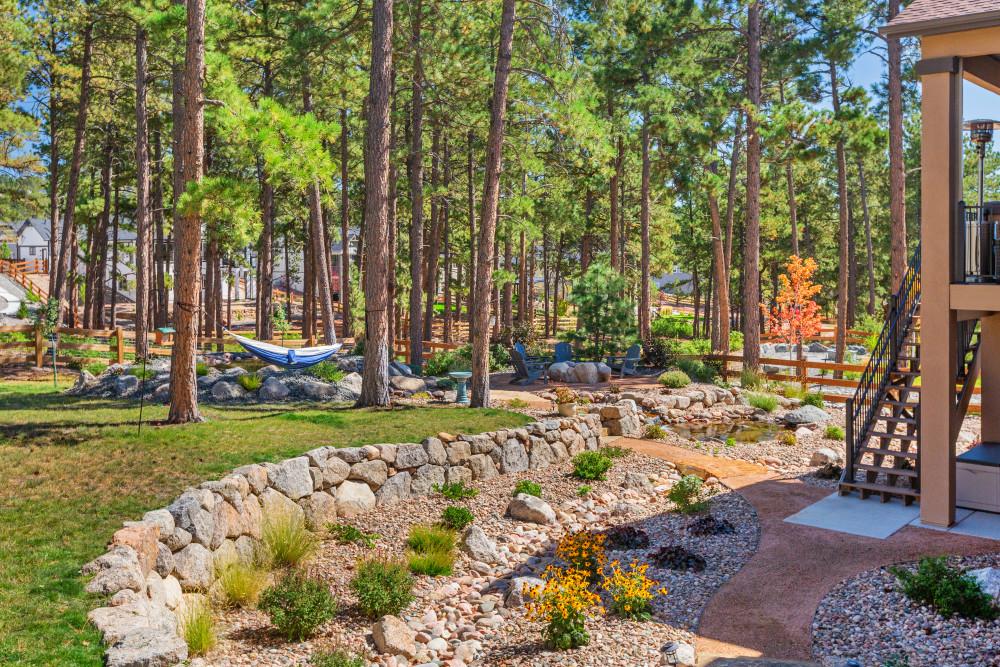
Not every drought tolerant yard has to look like a desert. This backyard sits under tall pines, with a low boulder retaining wall holding back a native grass slope and a dry stream bed winding down toward a small pond.
A hammock and fire pit chairs make it clear this is a space for relaxing, not just looking at.
Why it works:
- The boulder wall solves a grade change while adding real texture to the yard
- Native grasses along the slope need almost no supplemental water once established
- The small pond feature adds sound and movement without a thirsty lawn anywhere nearby
Landscape note: In a wooded lot like this, work with the shade instead of fighting it. Skip sun-loving perennials near the tree line and stick to grasses and groundcovers that tolerate dappled light.
Upgrade idea: A simple wood-plank bridge, like the one crossing the stream here, turns a drainage feature into a destination. It’s a small build with a big payoff for how the space feels to walk through.
This is the yard to show anyone who thinks “drought tolerant” and “backyard retreat” can’t be the same thing.
Frequently Asked Questions
What are the best drought tolerant plants for Colorado?
Russian sage, black-eyed susans, catmint, and native grasses like feather reed grass all handle Colorado’s dry summers well. Yucca and sedum work great too, especially in full sun spots with rocky or clay soil.
Is rock or mulch better for a xeriscape yard?
Both have a place. Rock lasts longer and suits high-traffic or drainage areas, while mulch feeds the soil and keeps roots cooler, so most yards on this list actually use a mix of the two.
How much should I water a new drought tolerant garden?
New plants still need regular watering for their first one to two growing seasons while roots establish. After that, you can cut back significantly, sometimes to just occasional deep watering during extended dry stretches.
Will my HOA approve a drought tolerant front yard?
Many Colorado HOAs now allow xeriscaping, especially with cities pushing water conservation. Check your community’s guidelines first, and consider keeping a thin lawn strip or tidy edging like a few examples above to ease the transition.
Can I convert my yard myself, or do I need a landscaper?
Smaller projects, like one bed or a dry creek section, are doable as a weekend DIY project. Larger yard-wide renovations with grading, boulders, or drainage work usually go faster and last longer with a professional.
Conclusion
Drought tolerant doesn’t mean giving up on a beautiful yard. If anything, these 12 examples prove the opposite.
Every yard on this list solves a real Colorado problem. Dry summers. Watering restrictions. Stubborn clay soil. And every one still looks like somewhere you’d actually want to spend time.
You don’t need to redo your whole property this weekend. Start small. Swap one thirsty bed for boulders and native grasses. Add a dry creek where water always pools. See how it feels.
Your yard will thank you, and so will your water bill.