The Ultimate Guide to Hydrangea and Boxwood Front Yard Landscaping

A front yard needs two things to really work: structure and softness. Boxwood gives you the structure. Its tight, evergreen form holds a design together in every season, even January.
Hydrangeas bring the softness. Their big, blowsy blooms soften all those clean boxwood lines and add color that changes with the seasons, from spring green to summer blue or pink to that dusty rust in fall.
Put them together and you get a front yard that looks intentional, not just planted. It’s one of the most reliable combinations in landscaping for a reason.
But pairing them well takes more than just putting both plants in the ground. Spacing, sun exposure, and layout all matter.
That’s what this list is for. Here are 13 ways to combine hydrangeas and boxwood into a front yard that looks good year-round.
Why Should You Go for Hydrangea and Boxwood Landscaping
This pairing shows up in so many front yards because it solves a lot of design problems at once.
Year-round structure.
Boxwood stays green through winter, so your yard never looks bare, even when the hydrangeas have dropped their leaves. That matters more than people think.
A front yard with only seasonal plants can look empty for half the year. Boxwood fills that gap and gives your landscaping a backbone that holds its shape no matter the month.
Built-in seasonal color.
Hydrangeas do the opposite job. They bring bold, changing color all spring and summer, right when the boxwood is at its quietest.
Many varieties even shift color as they age, moving from white or blue to soft green, pink, or rust by fall. That means your bed doesn’t just bloom once. It keeps evolving for months.
Low daily maintenance.
Once established, both plants ask for little beyond a yearly prune and consistent watering. Neither needs constant babying. Boxwood tolerates light pruning mistakes and bounces back fast.
Hydrangeas are forgiving too, as long as you water deeply during dry spells and skip heavy pruning at the wrong time of year. This isn’t a high-fuss pairing.
Works with almost any home style.
This combo reads as classic on a colonial, clean on a modern build, and cottage-y on a craftsman. It adapts to the house around it. Change the hydrangea variety, the bed shape, or the boxwood trim, and the whole feel shifts.
That flexibility is rare. Most plant pairings only suit one or two home styles, but this one adjusts to almost anything.
Forgiving for beginners.
Both plants are widely available, well-documented, and tolerant of small mistakes, which makes this a safe combo if you’re new to landscaping.
You’ll find hydrangeas and boxwood at nearly every garden center, and both have decades of growing guides behind them. If a plant dies or underperforms, replacing it costs little and rarely derails the whole design.
Boosts resale and curb appeal.
Real estate agents often point to foundation plantings as one of the first things buyers notice.
A tidy hydrangea and boxwood bed signals a well-kept home before anyone even walks inside. It’s a small investment that pays off if you ever sell.
Put simply, boxwood carries the yard when hydrangeas can’t, and hydrangeas bring the color boxwood can’t.
That balance, plus the low upkeep and wide style range, is why this pairing keeps showing up in the best front yards.
Also read: https://tidylivingideas.com/front-yard-hydrangea-landscaping-ideas/
13 Hydrangea and Boxwood Combos That Transform a Front Yard
1. Doorway Hydrangea Accent with Boxwood Backdrop
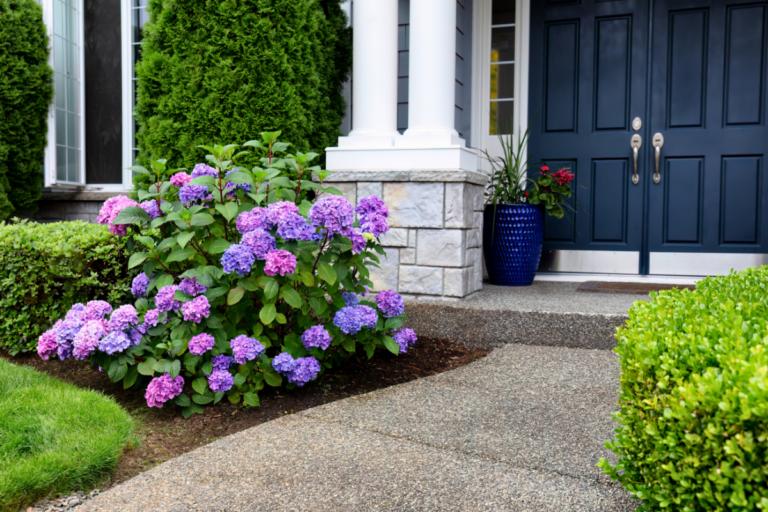
Your front door sets the tone for the whole house. This idea puts a single mophead hydrangea right beside the entry, with boxwood or arborvitae layered behind it for depth.
The blue and pink blooms do the talking. You don’t need a huge bed here. One well-placed hydrangea softens all that hard architecture, the columns, the stone, the concrete steps.
I like this idea for smaller entry gardens. It’s a low-commitment way to add color without redesigning your whole front yard.
Pair it with a potted accent plant by the door, like the one in this photo, and you get instant curb appeal in a tight space.
Best for: Small entryways and narrow beds beside the front door
Maintenance: Low to moderate; prune spent blooms and shape the boxwood once a year
Cost range: $40–$100 for one mature hydrangea plus a few boxwood shrubs
Pairs well with: Potted annuals near the door for extra color
2. Tall Panicle Hydrangeas Behind a Low Boxwood Hedge
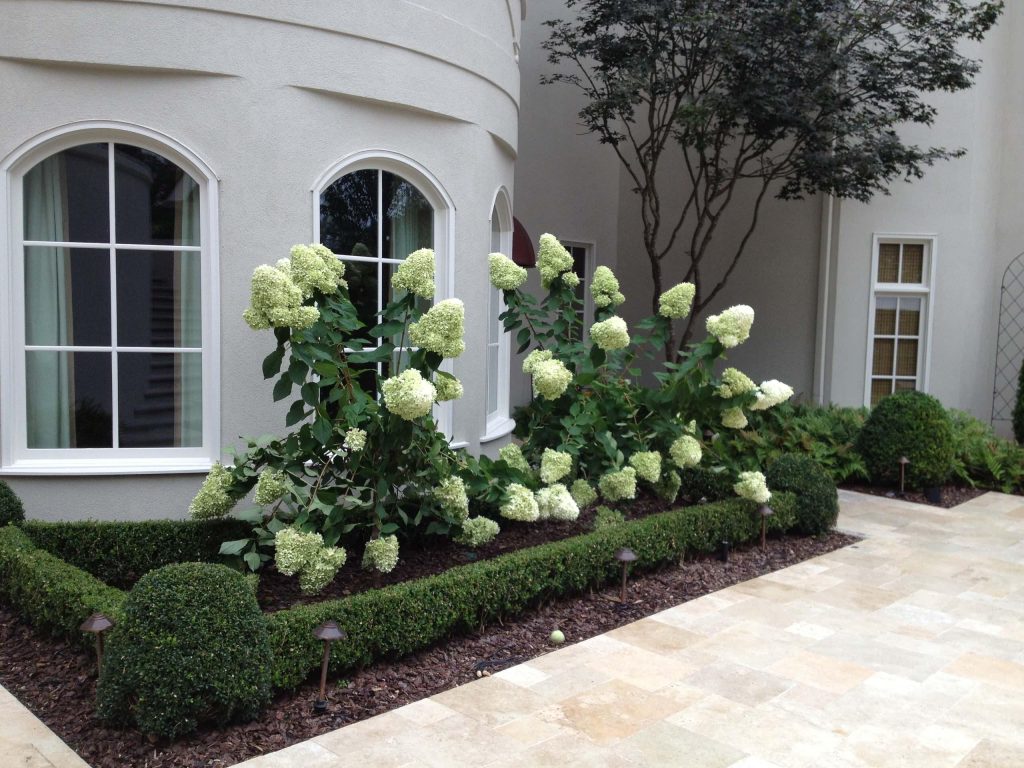
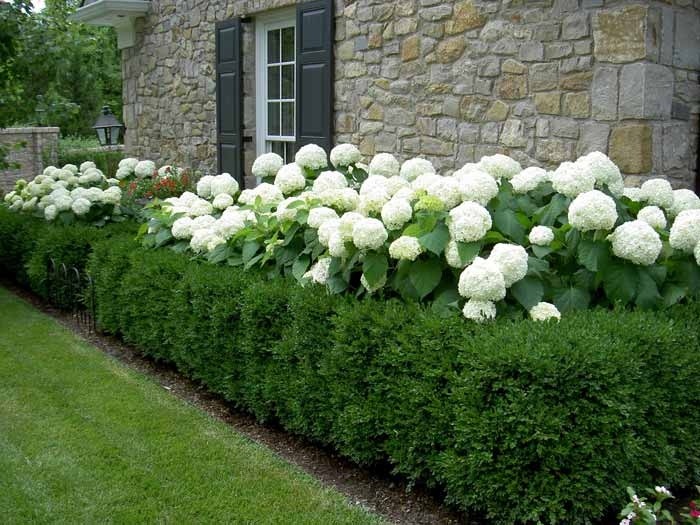
Panicle hydrangeas grow tall and upright, which makes them perfect for a backdrop planting. Set them behind a clipped boxwood hedge, and you get instant layering.
The boxwood keeps the bed looking crisp from the front. The hydrangeas rise above it and do all the volume and drama.
This works especially well along a patio or walkway, where you want privacy or a soft screen without blocking light. The cone-shaped white blooms age to a soft green, so the color shifts through the season.
I think this combo reads more formal than most hydrangea pairings. The straight hedge line does that.
Best for: Patios, walkways, and beds that need height without blocking a view
Maintenance: Moderate; panicle hydrangeas need a hard prune in late winter
Cost range: $60–$150 depending on hydrangea size and hedge length
Pairs well with: Round boxwood balls placed at intervals for rhythm
Also read: The Ultimate Guide to Tropical Front Yard Landscaping (12 Ideas Inside)
3. Curved Bed Edge with White Hydrangeas and Boxwood Balls
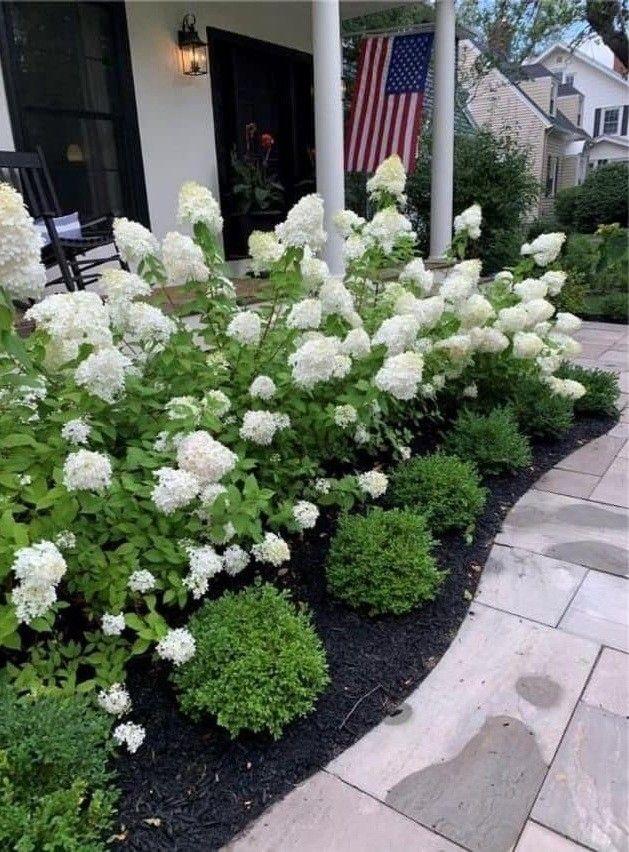
A curved bed always looks softer than a straight one. Here, white hydrangeas spill toward a stone path, with small rounded boxwood balls tucked in front.
Dark mulch makes the whole planting pop. It’s a simple trick, but it works. The black mulch sets off both the green boxwood and the white blooms.
This idea suits a wraparound porch or a bed that follows a walkway. The curve gives you flexibility. You can widen it near the door and taper it as it moves away.
I’d call this one of the easiest ideas on this list to adapt. You can scale the length up or down based on your yard.
Best for: Wraparound porches and beds that follow a curved walkway
Maintenance: Low to moderate; keep the boxwood balls shaped and deadhead hydrangeas as needed
Cost range: $100–$250 depending on bed length
Pairs well with: A dark mulch to boost contrast
4. Layered Mixed Border with Boxwood, Hydrangea, and Catmint
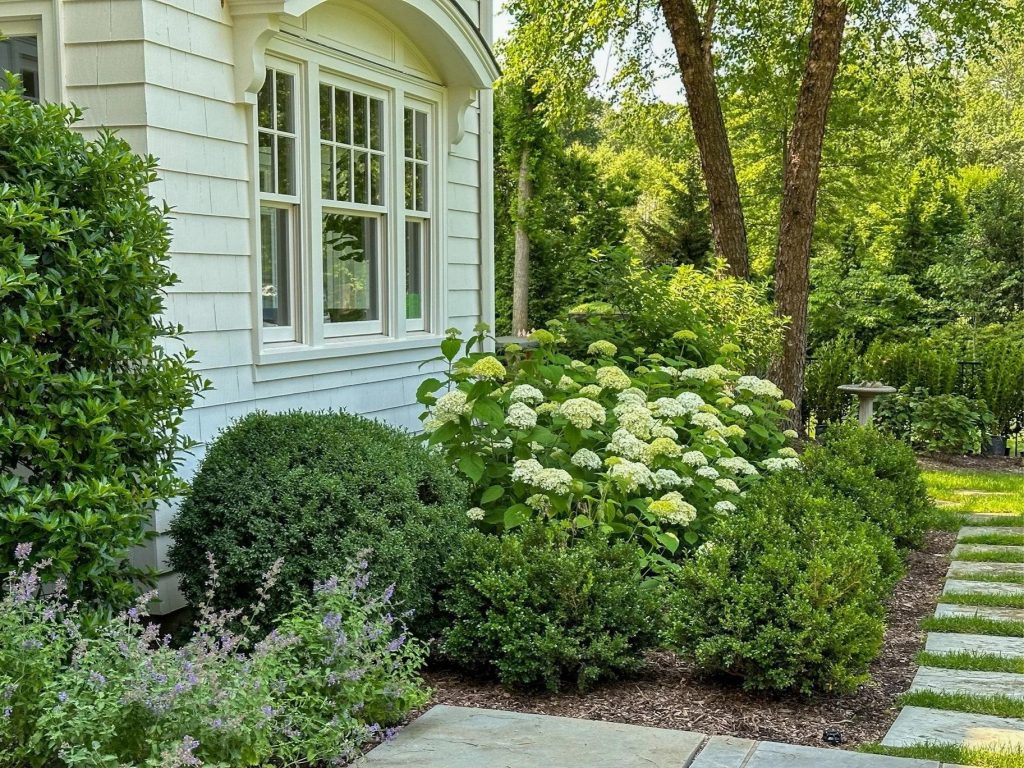
This one goes beyond just hydrangea and boxwood. It adds a third layer: catmint, planted low in front for extra texture and a soft purple haze.
The layering makes it feel less like a formula and more like a real garden. Large boxwood balls anchor the corners. Panicle hydrangeas fill the middle height. Catmint spills over the edge closest to the path.
I like this idea if you want more going on than just two plants. It still reads clean, but it has more personality.
Stepping stones running past the bed keep everything grounded and give the eye a place to land.
Best for: Foundation beds near windows or walkways where you want extra texture
Maintenance: Moderate; catmint benefits from a mid-summer trim to rebloom
Cost range: $80–$200 depending on how many layers you add
Pairs well with: Any low, mounding perennial with purple or silver foliage
5. Raised Hydrangea Bed with a Boxwood Hedge Border
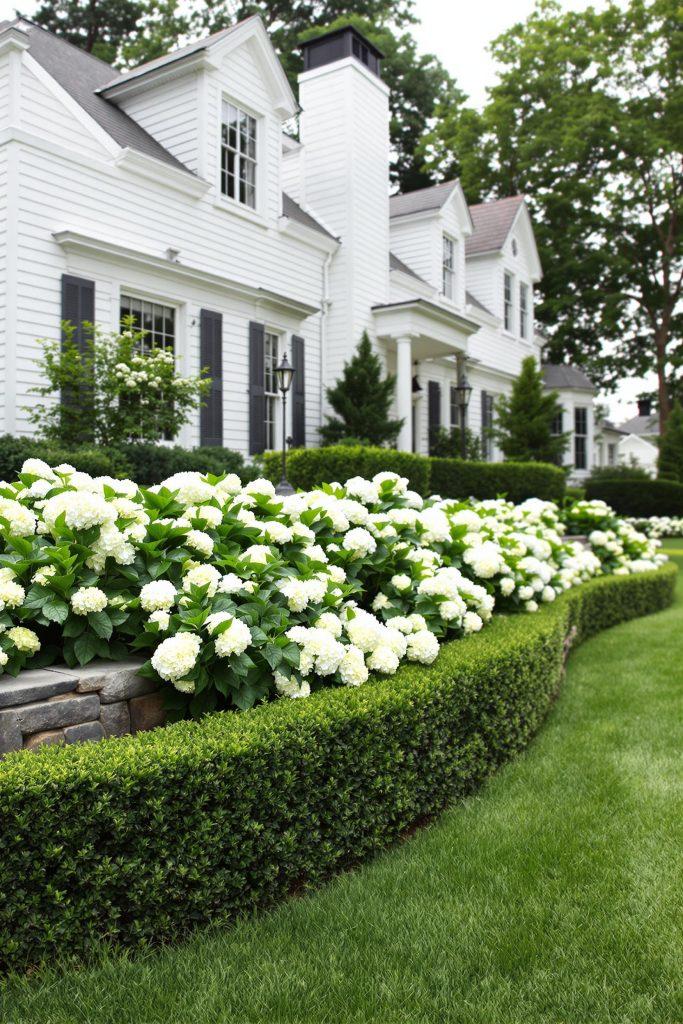
If your front yard has any elevation change, a raised bed can turn it into a feature. This idea uses a low stone retaining wall to lift the hydrangeas above the lawn.
A tight boxwood hedge runs along the base of the wall, softening the hard stone edge. Above it, a long run of white mophead hydrangeas creates a wall of blooms.
This is a bigger project than most ideas on this list. But it makes a serious visual statement, especially on larger properties.
I think the height difference is what sells this idea. It gives the hydrangeas a stage instead of just a spot in the yard.
Best for: Larger front yards with sloped or elevated beds
Maintenance: Moderate to high; retaining walls need occasional upkeep beyond the plants
Cost range: $500+ once you factor in the stone wall
Pairs well with: Landscape lighting tucked into the hedge line
6. Tree-Form Hydrangeas with a Boxwood-Edged Mound
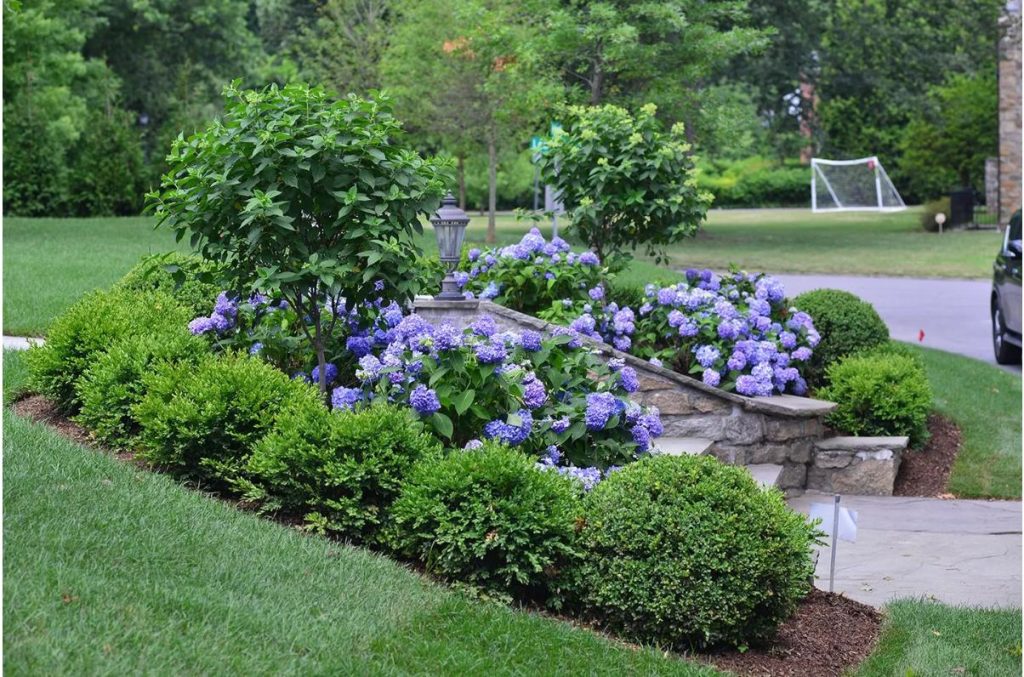
Tree-form hydrangeas look completely different from the shrub version. They’re pruned into a single trunk with a rounded canopy on top, like a small ornamental tree.
Planted on a mounded bed with a stone retaining edge and a boxwood border, they create real focal points. This works well near a mailbox, driveway entrance, or front walkway.
The purple mophead hydrangeas underneath fill in the lower layer, so the bed doesn’t feel empty near the ground.
I’d save this idea for a spot you want people to actually notice, like the corner where your driveway meets the street.
Best for: Driveway entrances, corner beds, and mailbox plantings
Maintenance: Moderate; tree-form hydrangeas need structural pruning to keep their shape
Cost range: $150–$300 per tree-form hydrangea
Pairs well with: A single lamp post or light fixture as a centerpiece
7. Pink Panicle Hydrangeas with Boxwood Balls on a Slope
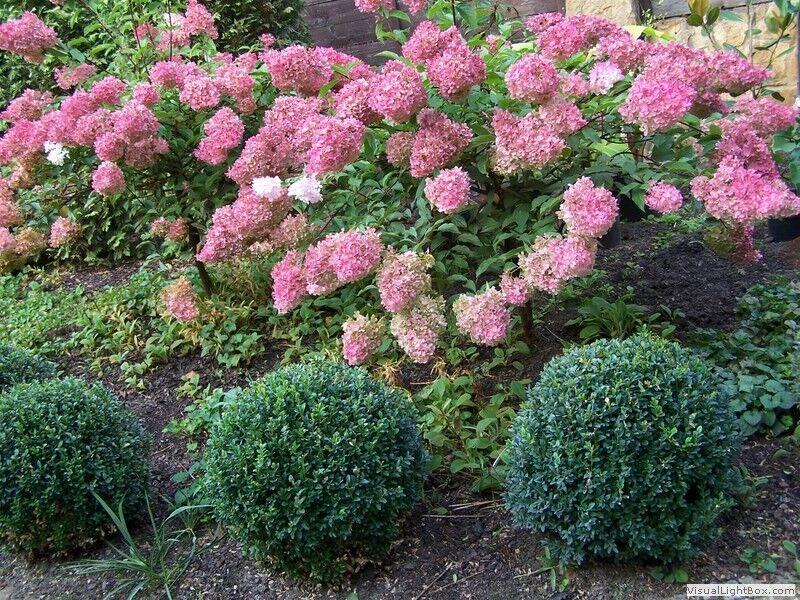
Sloped front yards are tricky to plant, but hydrangeas handle them well. This idea uses pink panicle hydrangeas along the top of a slope, with boxwood balls lined up below.
As the season goes on, the blooms shift from white to a deep, dusty pink. That color change gives the bed a completely different look in early fall than it has in midsummer.
The boxwood balls do double duty here. They anchor the slope visually and help hold soil in place along the lower edge.
I like this pairing for anyone dealing with an awkward grade change in the front yard. It turns a landscaping problem into a feature.
Best for: Sloped front yards and beds with a grade change
Maintenance: Low to moderate; prune panicle hydrangeas hard in late winter
Cost range: $100–$250 depending on slope length
8. Potted Hydrangeas Flanking the Front Steps
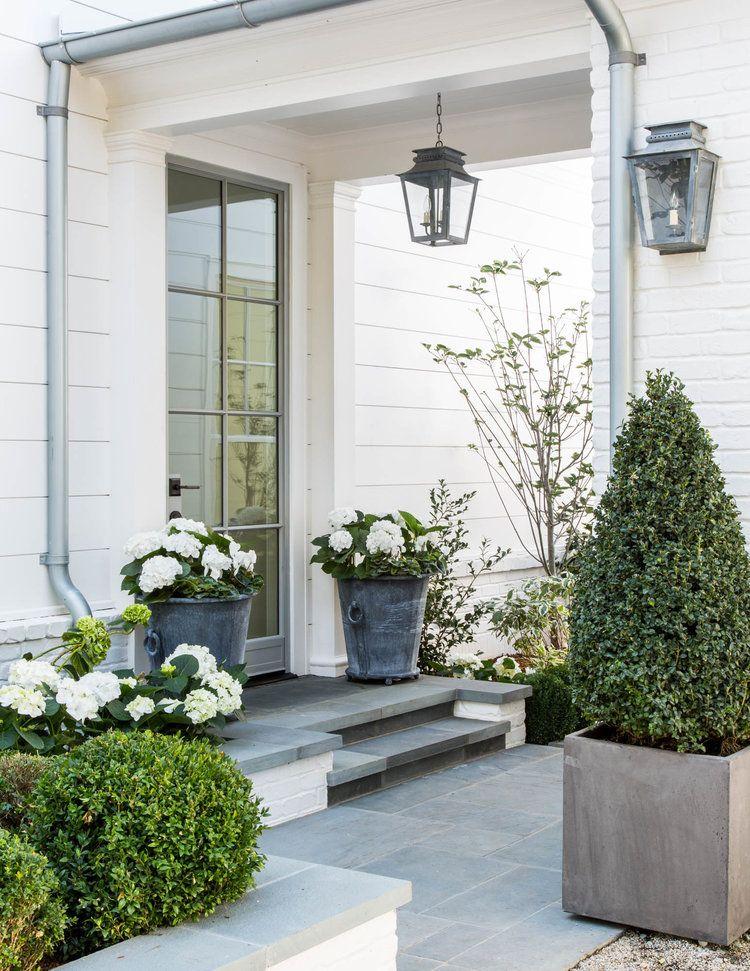
Not every front yard has room for a big planting bed. This idea skips the ground entirely and puts hydrangeas in tall metal planters on either side of the steps.
A cone-shaped boxwood in a matching planter adds height on one side. The result feels polished without needing any digging.
I really like this idea for rentals or newer homes where the beds aren’t established yet. Pots let you rearrange things or swap plants out each season.
Just remember, potted hydrangeas dry out faster than ones in the ground. You’ll need to check the soil more often, especially in summer.
Best for: Front steps, porches, and rentals where digging isn’t an option
Maintenance: Moderate; potted plants need more frequent watering than in-ground beds
Cost range: $80–$200 for planters, hydrangeas, and a boxwood accent
Pairs well with: Matching lantern-style outdoor lighting
9. Pink Hydrangea Hedge Along a Brick Foundation
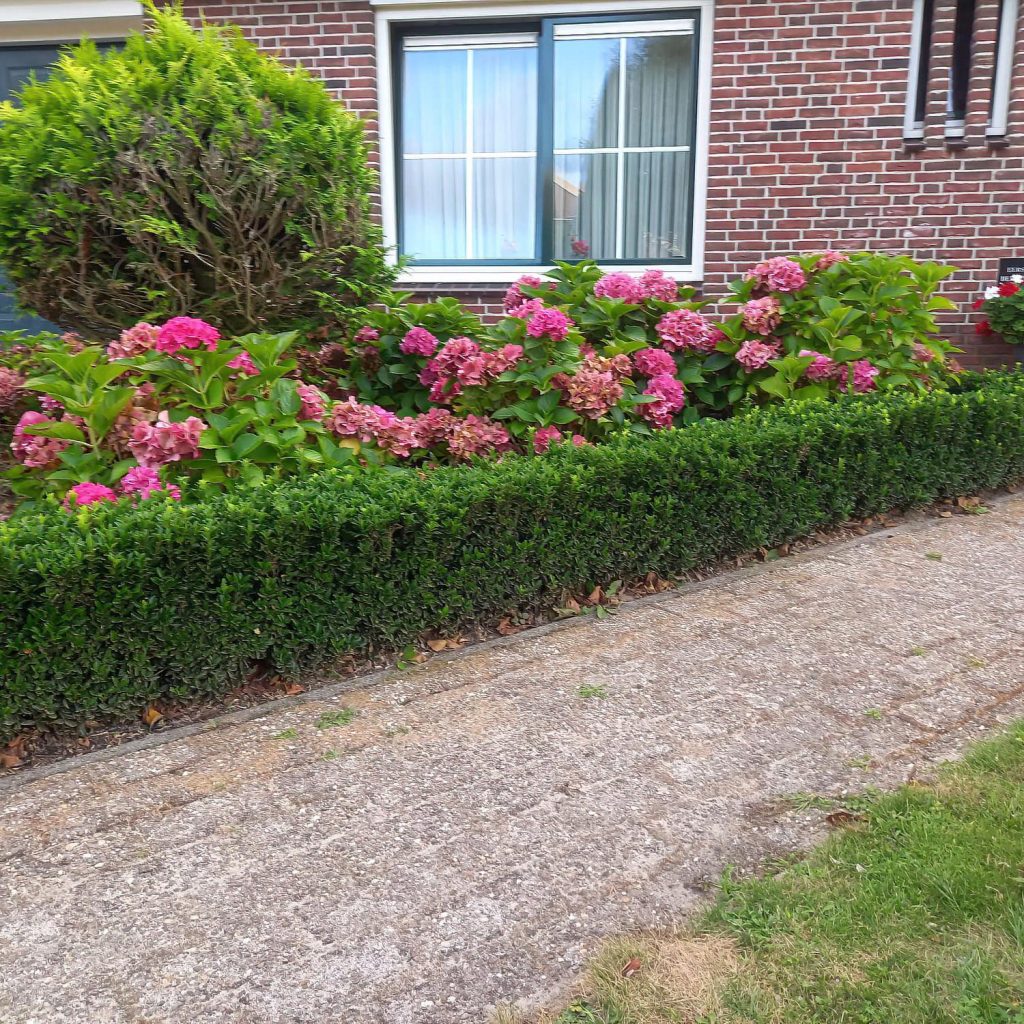
If you want serious color without much fuss, plant a straight run of pink hydrangeas right along your foundation. Keep a low boxwood hedge trimmed in front to frame the base.
This idea works especially well on brick homes. The pink blooms stand out beautifully against red brick, and the hedge below keeps the whole bed looking tidy even when the flowers fade.
I like how simple this is to maintain. One hedge line, one row of hydrangeas, no extra layers to fuss over.
It’s a great starter idea if you’re new to foundation planting and want something forgiving.
Best for: Brick homes and foundation beds under front windows
Maintenance: Low; trim the hedge a couple times a season and prune hydrangeas once a year
Cost range: $80–$180 depending on hedge length
Pairs well with: A straight concrete or gravel path running alongside
10. Formal Bed with White Hydrangeas, Boxwood, and Ornamental Grass
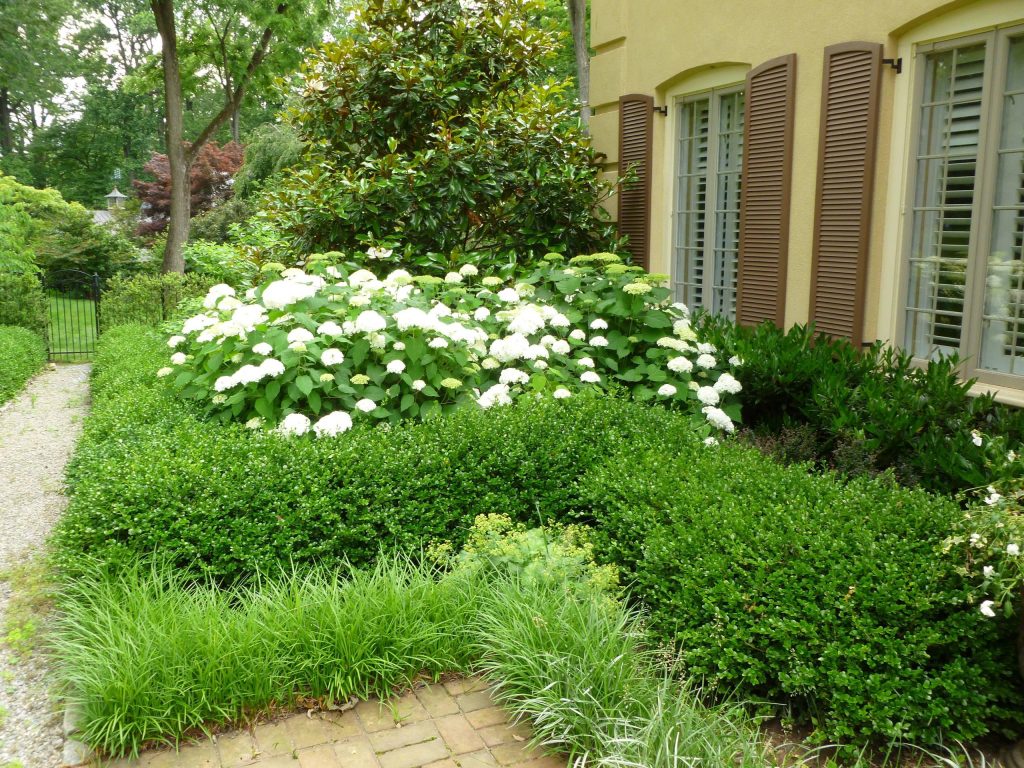
This is one of the more layered ideas on this list. It combines clipped boxwood hedging, white hydrangeas, and a tall shade tree like magnolia for a bed with real depth.
The boxwood stays low and tight along the path. The hydrangeas fill the middle. The tree canopy overhead ties the whole planting back to the house.
I think this idea suits older or more traditional homes best. It has that established, been-here-for-years look, even if you just planted it.
Ornamental grass or liriope along the path edge adds a soft, grassy texture that keeps the formal layout from feeling stiff.
Best for: Traditional homes and larger foundation beds with some shade
Maintenance: Moderate; layered beds need more regular shaping to stay neat
Cost range: $200–$400 depending on how many layers and plant sizes
Pairs well with: Liriope or mondo grass as a soft path edge
11. Blue Hydrangeas with Ornamental Grass and Boxwood Balls
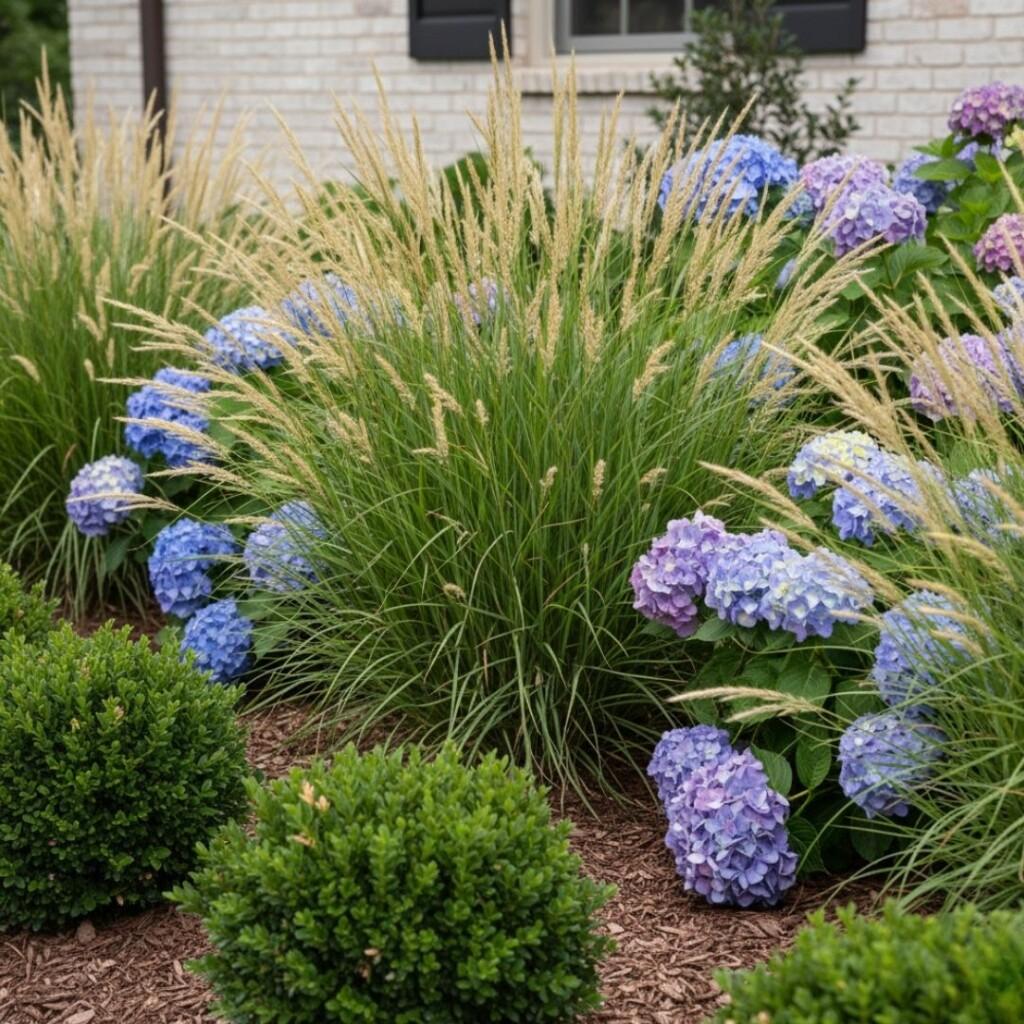
Ornamental grass isn’t a plant you’d normally pair with hydrangeas, but it works. The airy, upright blades give blue hydrangeas something to contrast against, texture-wise and color-wise.
Round boxwood balls in front ground the whole bed and keep it from looking too wild. Mulch between the plants keeps weeds down and makes the blue blooms pop even more.
I’d recommend this idea if your front yard already leans a little modern or naturalistic. It reads more relaxed than a straight hydrangea-and-boxwood hedge.
Grass also adds movement. It sways in the wind, which most foundation plants don’t do.
Best for: Modern or naturalistic front yards that want texture and movement
Maintenance: Moderate; cut ornamental grass back hard each late winter
Cost range: $100–$250 depending on bed size
Pairs well with: Blue or purple hydrangea varieties for cohesive color
12. Cottage-Style Hydrangea Border Along a Brick Path
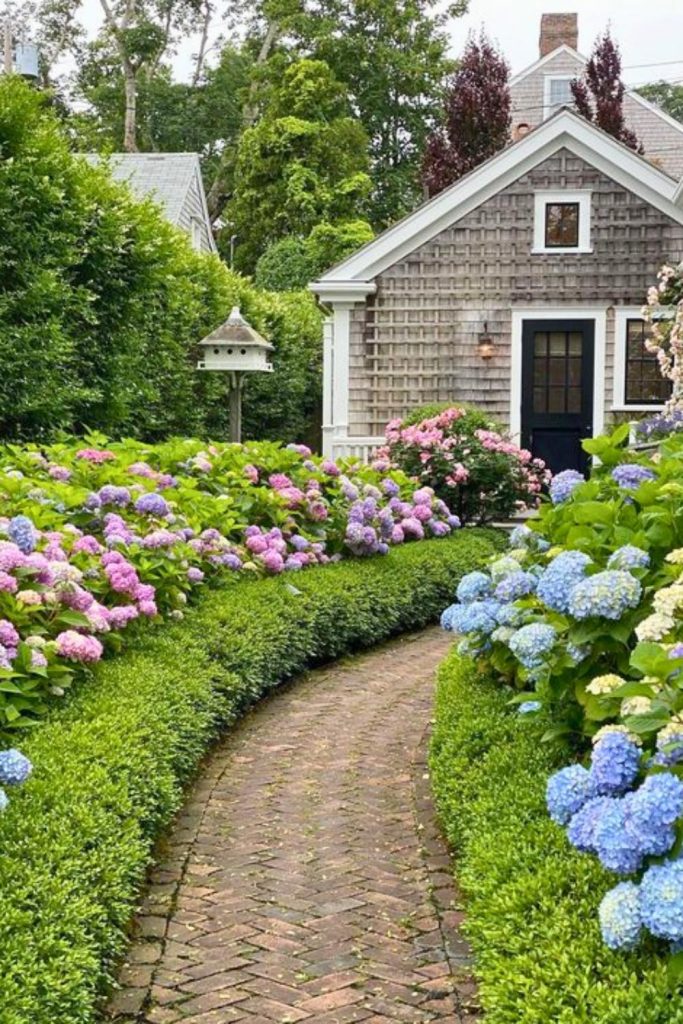
This idea leans fully into cottage garden style. Pink, purple, and blue hydrangeas grow in loose, full masses along both sides of a curving brick path, with a low boxwood hedge keeping the edges defined.
It’s less structured than most ideas on this list, but the hedge line stops it from looking messy. That’s the trick with cottage-style beds. You need one crisp element to hold everything else together.
I love this idea for older homes or anyone who wants their front yard to feel like a real garden, not just foundation plantings.
Mix bloom colors freely here. Cottage style thrives on variety instead of matching everything.
Best for: Cottage-style homes and front yards with a walkway to the door
Maintenance: Moderate; loose plantings still need the hedge trimmed to stay crisp
Cost range: $150–$350 depending on path length
Pairs well with: Climbing roses trained along the house
13. Symmetrical Entry Planting with Spiral Topiary and Hydrangeas
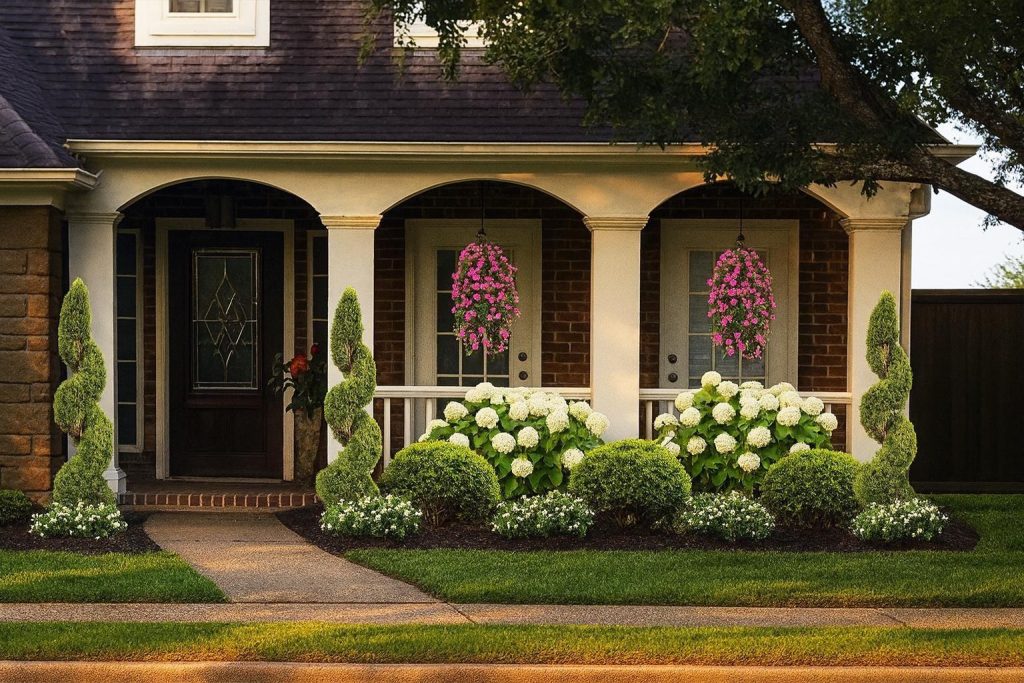
For a front entry that feels grand without being over the top, try mirroring the planting on both sides of the door.
Spiral-trimmed evergreens stand tall at each corner, white hydrangeas fill the middle, and boxwood balls plus low white flowers finish the base.
Symmetry does a lot of heavy lifting here. Even if your hydrangeas bloom a little unevenly, matching the layout on both sides makes the whole entry look intentional and cared for.
I’d save this idea for a front door that’s already a focal point, like one with a porch or archway. It deserves the extra structure.
Hanging baskets on the porch add a pop of color up high, balancing the greenery below.
Best for: Symmetrical entries, porches, and homes with an archway or portico
Maintenance: Moderate to high; topiary spirals need regular shaping to hold their form
Cost range: $300–$600 for the full symmetrical setup
Pairs well with: Hanging baskets on the porch for added height and color
Frequently Asked Questions
Do hydrangeas and boxwood need the same amount of sun?
Not exactly, but they overlap enough to work well together. Most hydrangeas prefer morning sun and afternoon shade, while boxwood tolerates full sun to partial shade.
Plant them where they get at least four hours of light, and both should thrive.
Can I mix different hydrangea varieties in one bed?
Yes, and it often looks better than sticking to one type. Panicle, mophead, and smooth hydrangeas all have different bloom shapes and bloom times, so mixing them stretches your color and interest across more of the season.
How far apart should I space hydrangeas and boxwood?
Give hydrangeas three to five feet of room, since most varieties spread wide at maturity. Boxwood can go closer together, usually one to two feet apart, if you want a tight, continuous hedge line.
Will boxwood and hydrangeas survive winter in colder climates?
Both handle winter fine in most US zones, though panicle hydrangeas are the hardiest choice for colder regions. Boxwood may need a burlap wrap in especially harsh winters to prevent windburn on the leaves.
Is this landscaping combo budget-friendly?
It can be, depending on plant size and bed length. Starting with smaller boxwood and one or two hydrangeas keeps costs low, and both plants fill in well over a few seasons as they mature.
Final Thoughts
Hydrangeas and boxwood work because they cover each other’s weak spots. One brings color, the other brings structure, and together they hold up in almost any front yard.
Start small if you need to. Even a single hydrangea backed by a few boxwood shrubs can change how your whole entry looks. Pick the idea that fits your space, and let it grow from there.